Earthrise by Amanda Gorman
Thursday, January 21, 2021


Sunday, February 2, 2014
CLIMATE CHANGE - UNIVERSITY OF EXETER - Week 2
This is the reflection for the second week (January 20-26) since I am a bit behind (ha!). The second weeks lesson was really fascinating because it was covering primarily paleo-climate information. Prior to week 2 readings I had only the haziest notion of paleo-climate, so it was really informative.
I understand that of necessity the paleo-climate models they provided us were simplified (nothing about ocean currents for example in discussing mechanisms of climate), but despite being simplified they were quite powerful in providing explanations for the major long term changes in earth's climate.
First important discovery: our sun, Sol, puts forth substantially more energy today than it did 4.4 Billion years ago when the solar system and Earth was formed. Now before someone goes "ah ha! that's what's driving global warming today" let's quickly put that to rest. We are talking a slow, gradual warming for the entire 4.4 Billion year period - which covers both much warmer and much colder geological periods, and has little to do with the dramatic increase in temperatures observed in just the past 150 years since the start of the industrial age.
So 4.2 Billion years ago (once the surface of the planet settled down enough to result in rock evidence we can still find today), the sun was substantially weaker, and earth received substantially less solar radiation. The estimate is 20 to 30 percent less energy output 4.2 Billion years ago (https://www.sciencenews.org/article/faint-young-sun). This creates a bit of a puzzle: if we were to suddenly lose 20 to 30 percent of the sun's energy today, our world would plunge into a bitter freeze. The earth's surface would be so cold that there would be no liquid water left. But geologists and paleo-biologists can demonstrate to us in the form of fossils, and evidence of rain and water weathering that there was abundant liquid water on the surface of the earth 4.2 Billion years ago. So how come the earth was warm enough for liquid oceans, rain, streams and lakes even though there was less radiation from the sun. The most accepted hypothesis is that the earth's atmosphere was much denser and had much higher levels of carbon dioxide, methane, and combinations of nitrogen and oxygen that facilitated heat absorption. One source of these greenhouse gases would have been volcanoes. This is still an area of research and discussion to find the precise mechanisms for the warming.
A new puzzle arises when one asks the question, well if the earth were as least as warm as it is today, with less sunlight and more greenhouse gases, why didn't the earth get consistently hotter over time? The key to that is in chemical and geological processes that remove carbon dioxide from the air and lock it up in rocks in the earth's surface. Particles of carbon dioxide are absorbed by water vapor and create rain, a lightly acidic rain (carbonic acid rain) that over time weathers (chemically wears down) the rocks of the earth's surface. Rain run-off in streams and rivers carries that rock and carbon bearing water into the oceans where the carbon and other minerals from the rock are used by tiny living creatures in the oceans to build their bodies and their shells. When they die, their remains filter to the bottom of the ocean and provide the sediments that become sedimentary rocks. Constant weathering and the growth of living species removes carbon from the atmosphere over the billions of years that the sun grew brighter.
About 2.2 Billion years ago a new puzzle emerges. For the first 2 billion years the earth's climate experienced swings from warmer to cooler, with the shrinking and growing of the earth's icy poles bearing witness to those swings. But at about 2.2 Billion years ago the geological evidence strongly supports the idea that the whole surface of the earth froze over, creating what is called "snowball earth". There are a variety of things that might have caused a cooling cycle, and physicists have determined that if as much as two-thirds of the earth's surface became covered with ice and snow, then the dramatically increased albedo (reflection back into space of sunlight) would reach a tipping point and there would be nothing to stop the earth from freezing entirely, which is apparently exactly what happened. The true puzzle becomes, how did the earth emerge from that frozen state to return to millions of years of much warmer climates? The key seems to be in the continuation of volcanic action throwing more greenhouse gasses into the atmosphere, but with all surface water frozen there was no rain to wash the carbon dioxide out of the air, create carbonic acid rain, and engage in rock weathering that would sequester the carbon in the earth's surface. So the concentrations of greenhouse gases increased, and increased and increased until the air was warm enough to begin melting the ice ball.
To me the most significant aspect of all this information is that the basic mechanism of climate - sunlight and greenhouse gases were the same 4.2 billion years ago as they are today, the only difference is that today we industrial humans are inputting significant additional carbon, methane, etc. into the atmosphere with our economic activity. We are taking carbon that was sequestered in the earth's crust for billions of years, hauling it out, burning it and returning it to the atmosphere. So that in 2013 the Mauna Loa monitoring station measured 400 ppm of atmospheric carbon dioxide, a level not seen on earth for the past 2 million years.
Saturday, January 18, 2014
CLIMATE CHANGE - UNIVERSITY OF EXETER - Week 1
Even though I've been teaching about climate change for 15 years, there's still a lot of the science I don't fully understand, and I'm also always looking for ideas on how best to communicate complicated ideas about the environment to my undergraduate students, and how to engage them more fully in learning. So I happened across this link to Future Learn an on-line learning consortium of British universities, and in particular to an undergraduate oriented course on climate change. It's eight weeks long, free, and so far seems quite engaging. This is not my first on-line learning experience (I also teach mostly on-line classes) but it is my first experience with a MOOC, and with a course that has such high production values.
One of the things that we are encouraged to do in this course is to use a blog to engage in "reflective learning." At first I thought about creating a whole new blog, but that seemed redundant given that Blue Island Almanack was just sitting here unused for the past four years. So here I am!
Week 1 covered a lot of basic material. So I was surprised to find that there were a number of things that were new to me, or that I understood better by the end of the week than previously because of the skill with which they had been explained.
The first little surprise was the explanation for why "greenhouse" is not the best analogy for how our atmosphere holds heat. The glass of a literal greenhouse does not prevent long wave (heat) radiation from leaving the greenhouse. This was new to me, simplistic explanations given to me years ago said that the glass prevented the heat from escaping, turns out that is not quite correct. Long wave (heat) radiation does escape through greenhouse single pane glass. However, the glass does provide a physical barrier to wind that would remove heat by convection. This makes so much sense to me - I spent two summers of my life (1970 and 1971) working in greenhouses planting and taking cuttings from chrysanthemum plants, and know what the heat of a greenhouse is like.
A better analogy for how the earth's atmosphere retains heat is NASA's temperature regulating blankets . This high tech blanket is embedded "millions of invisible microcapsules that absorb excess heat when you are hot and release the stored heat when you are cold, ensuring a comfortable temperature and humidity." In the earth's atmosphere the "microcapsules" that absorb and release heat are molecules of the various greenhouse gases: water vapor, carbon dioxide, methane, ozone, CFC's and nitrous oxide. Which brings up another new factor I encountered this week: I'd never heard water vapor called a "greenhouse" gas previously. It is different from the other greenhouse gases listed, because it changes in concentration as temperature changes. Water vapor does absorb and release heat, but water vapor increases when temperature increases and decreases when temperature decreases, so it is an important feedback greenhouse gas, but not a "forcing" gas that changes concentration due to non-climatic events.
The most interesting thing I got from this week was this diagram that helped me understand several important aspects of our atmosphere and how it promotes life and affects climate.
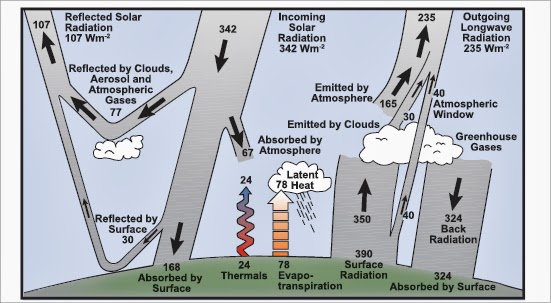
FAQ 1.1, Figure 1. Estimate of the Earth’s annual and global mean energy balance. Over the long term, the amount of incoming solar radiation absorbed by the Earth and atmosphere is balanced by the Earth and atmosphere releasing the same amount of outgoing longwave radiation. About half of the incoming solar radiation is absorbed by the Earth’s surface. This energy is transferred to the atmosphere by warming the air in contact with the surface (thermals), by evapotranspiration and by longwave radiation that is absorbed by clouds and greenhouse gases. The atmosphere in turn radiates longwave energy back to Earth as well as out to space. Source: Kiehl and Trenberth (1997). URL: http://www.ipcc.ch/publications_and_data/ar4/wg1/en/faq-1-1.html
The nature of energy exchange is that for every watt of energy that comes in from the sun (342 Watts per square meter) an equal number of Watts energy (325 + 107 = 342 Watts per square meter) must be radiated back into space. If all that energy came in and went out directly the surface of the earth would average a temperature of -19 degrees Celsius, which is obviously too cold for human (or most other type of) life. What happens is that greenhouse gasses (listed above but especially water vapor and secondarily carbon dioxide) absorb the heat for a while and bounce it back into the atmosphere. This bounced back radiation called logically "Back Radiation" is crucial for making life livable. The heat gets to bounce around for a while longer, raising the temperature of the atmosphere near the surface to an average of 14 or 15 degrees Celsius - a much more hospitable climate. Ultimate all that heat energy does leave and the total amount emitted does equal the amount that comes in from the sun, but there is this time delay, allows the lower atmosphere to reach a warmer temperature. The upper atmosphere where the final heat exchange does occur is -19 degrees Celsius.
Suddenly it all makes sense!
The other thing that really helped me this week was some nice organizing lists that helped me order some information that I already had. The Radiation Balance of the Earth is the equation that looks at all the factors found in that diagram above - how much energy comes in, how much is reflected, how much is absorbed, how much crucial back radiation there is and of course how much is ultimately radiated back to space. While it is always true that the ultimate amount radiated back to space must equal the incoming solar amount, the proportions that are reflected, absorbed by the surface and Back radiation can vary.
There are three fundamental ways to alter the complex equation that is the radiation balance of the earth. First factor, the amount of radiation in coming from the sun can change. This is due to two things: a) changes in the sun itself that affect the sun's energy output and b) changes in the earth's axis tilt and orbit around the sun which affect the time and angle at which sunlight strikes the earth. Second factor is changes in albedo or reflectiveness of the earth - how much of the sun's short wave radiation (light, ultraviolet, etc.) is reflected back before it can warm the earth's surface. Things that change albedo are: the amount of surface covered by ice and snow (highly reflective), the amount of vegetation on the surface (a forest reflects less than a desert), the amount of cloud cover (tops of clouds reflect light back), and the amount of particulates and aerosols in the air - the more aerosols the greater the reflectivity (particulates and aerosols can be naturally occurring from volcanoes, or man-made from smokestacks and car exhausts). The third factor concerns the altering of long wave (heat) radiation patterns, changes that affect the amount of heat immediately radiated into space versus the amount of Back Radiation there is - the amount of heat held and returned to the atmosphere for a while before it is ultimately dissipated into space. The third factor is affected by the chemical composition of the atmosphere, such as changes in water vapor, carbon dioxide, methane, ozone, CFC's and nitrous oxide.
I knew all those things, but that's a nice organizing schemata!
Saturday, July 31, 2010
one small proposal for gettting from here to there
Our earth is undergoing measurable global climate warming that has a significant anthropogenic component, with the primary anthropogenic contribution to warming coming from the steady increase in CO2 emissions from the use of fossil fuels such as oil and coal. Moreover, warming that has already occurred over the past century and warming that is certain to occur in the next century, have had and will have recognizable negative impacts on the health of human beings and human societies. Those impacts include, but are not limited to, rises in sea level and loss of shoreline, changes in plant and animal populations (declines, increases, shifts in range) including changes in disease vectors (such as West Nile Virus and Malaria carrying mosquitoes), increasing drought with its impact on food crops and human water supplies, and increasing extreme precipitation events with concomitant flooding.
Among the scientific community there is debate and need for continuing research on how much warming and how fast future warming will occur, and the regional patterning of impacts, but there is general consensus on the basic facts of warming and its causes and its consequences. Recent polling of the general population in the United States shows that about three quarters of the American population accept the scientific consensus on the reality of global warming and the anthropogenic causes of that warming. However, there is a decided lack of consensus both within the scientific community and the general population on exactly what should be done to address the problems posed now and in the future by global warming.
Just because people agree that a problem exists and that something should be done, has never meant that they will agree on what to do about that problem. This has always been true. There are lots of good sociological and psychological reasons for this lack of agreement. From a psychological perspective immediate, present threats to one's livelihood and material well-being are more salient and real than predicted future threats no matter how real we consider those future threats to be. A parent will always be more concerned about the present day need to keep a roof over their children's heads and food on the table today, than they will be about the availability of housing and food for those children in 20 years.
From a sociological perspective we have organized our economy around the need to maintain very short term current profitability to retain investors, rather than around long term future. The structures, rules and practices of business decision-making and investor decision-making, make it difficult for either business managers or investors to forgo current profits in exchange for long term sustainability.
For a utility company currently generating most of its electricity from coal fired plants shifting to solar or wind generation has many economic drawbacks. If a utility simply purchases "green" power from another electricity producer who is already invested in wind, solar or hydro-power, the primary profit from power production goes to the actual producer not the utility company purchasing the power. To make any profit, they have to raise the cost of that power to the customer, making it more expensive than the coal generated power, and thus less attractive to consumers of electricity. Such a move also introduces greater inefficiencies -- the further electricity is transmitted the greater the loss, so purchases power from a distant provider means that you get less power for your buck as well.
On the other hand, if a utility company decides to themselves begin producing electricity from wind, solar or hydro sources, there is the huge upfront capital investment that must be made. While this may have great long term profit potential (once constructed one never has to pay for sunlight or wind unlike coal), it has tremendous short term costs that affect profitability and investor satisfaction. If a utility attempts to pay for this by raising utility rates up front, there is substantial customer dissatisfaction, and in states (like Kentucky) with strong political incentives to protect coal, little political interest for public utility commissions to support such rate increases. Additionally, the construction of a centralized solar or wind generation plant requires huge acreage, that may not be readily available to a utility company near its customer base.
Finally, another reason that utility companies become nervous about discussions, is that the idea mode of generating electricity from solar energy is a pattern of dispersed, household level or building level generation, where solar panels sufficient to the needs of a particular housing unit or office building are placed on the building itself. This eliminates two problems: first, all the extra land that would be needed for centralized solar generation, and second, the problem of electricity losses due to transmission over distance. However, since currently housing unit and office building solar electricity generation is financed and operated by individual families or businesses it represents a loss of revenue for the utility company, and certainly not something they really want to encourage.
Moreover, from the point of view of the individual, family or business, the cost of constructing small localized solar (and wind) generation is quite large (at least $20,000), and far beyond the reach of the median household. While such household level solar (and wind) electricity generation does pay for itself over twenty to twenty-five years (the vast majority of the costs are in the initial hardware and installation and after that the electricity itself is essentially free), the upfront costs are prohibitive for all but the most affluent and most environmentally committed.
Now, finally to my proposal. I acknowledge up-front, as a person who is uncomfortable with the power of utility companies now, this is not my ideal solution, but it is a means of decreasing the input of CO2 into the atmosphere, to ameliorate future extent of global warming and its impact, while dealing with many of the problems outlined above. My proposal is that electric utility companies currently heavily invested in their own coal-fired generation consider adopting the model used by Bell Telephone in the 1950's. In exchange for a modest installation fee (say a few hundred dollars that could be prorated over a period of time) well within the budgets of middle and working class families with "green values," the utility company would deliver and install solar panels on the consumers home -- but, and here's what I think is a new idea (at least as applied to electricity generation) the utility company would retain ownership of those panels in perpetuity, and charge the consumer a monthly fee for the electricity consumed from those panels.
Here's the details -- the one's that I think would make this idea appealing to both the consumer and to the utility company. The individual solar installations would 1) be large enough to provide for ordinary, peak daylight hours electricity use and 2) would be tied into the grid allowing for both inflow and outflow. The utility company would benefit, because all excess electricity generated would flow into the grid for use by other customers (and unlike the situation where a household customer owns the solar installation, the utility company would own that excess flow outright and not be paying the customer with the installation for it). With each household or business that added solar generation, the electricity generating capacity of the entire grid would be expanded. The capitalization costs would be spread out over time -- no huge up-front investment in generation capacity years before any new power can be generated. Moreover, following current phone company and cable company practices, the utility company could charge a very small (a few dollars) monthly maintenance fee to consumers, to cover costs of periodic maintenance and repair.
The consumer would benefit in two ways: they would have the assurance that in the absence of sunlight they would still have electricity, and conversely, during widespread power outages due to downed transmission lines they would also still have their locally generated power. Indeed, if several households in a neighborhood had contracted with the utility for solar panels, the entire neighborhood circuit might be protected from electricity loss during a widespread outage.
In the beginning only middle income and upper income families that are highly committed to environmental, "green" values would participate. I know I would. I would be very willing to pay a reasonable premium in installation costs just to be assured that while I was sitting at my computer typing away I was using electricity generated by solar power rather than by coal obtained by scalping the mountains around me. Overtime, as people begin to notice, that one of their neighbors still has electricity after a storm has knocked out everyone else, the appeal of solar panels might spread. If the utility made the cost of electricity generated in situ from the solar panels marginally less expensive (say 1/2 cent per KWH) compared to electricity pulled from the grid, this would increase the appeal of participation.
From the utility company's perspective, they are able to gradually expand their generating capacity, using "green" sources, with small, periodic expenditures of capital that can be partially charged to the customer (installation fees), and also recouped by feeding all excess electricity generated into the grid. Customers without the panels who depended solely on the grid would pay the standard rate for their electricity. By dispersing solar generation through out the households served by a utility, there would be a substantial increase in efficiency, as electricity would be consumed closer to where it was generated, reducing the losses to long distance transmission. Most of all this idea allows utility companies to make the transition to renewable electricity generation gradual and incremental, and thus less painful and more acceptable.
So there is my idea -- somebody tell me what's wrong with it!
Saturday, July 24, 2010
weather is not climate, but....

The Weather Channel's website has a number of nifty new features. One of which provides you with lots of information about how your current month (and previous month) stack up against historical weather patterns. I've captured the screen shots for my zip code 41825, for June 2010 and July 2010.  Notice that for both June and July the "highest temperature recorded so far" is higher than the historical record for that month -- so we broke the all time temperature records for both June and July in Eastern Kentucky. Notice also that the total rain fall amounts for both June and July are well below the average. June's precitipation total was 1.05" below the average. Of course July isn't over yet, but let's hope we don't get 3.65" of rain in one week. While the July total rain is more than three and a half inches below normal, eastern Kentucky did get one whale of a gully-washer, to the great dismay and anguish of hundreds of folks in Pike county.
While it is important to remember that weather is not the same as climate, and unusually hot days occur periodically, as do droughts and floods, overall warming of the climate as is currently occurring on planet earth, does give rise to more frequent extreme heat, more common droughts, and paradoxically more frequent intense rain events like that seen in Pike County this month.
Monday, July 5, 2010
Where are the global warming deniers?
The first thing to remember is, as any competent climate scientist will tell you, weather and climate are NOT the same thing. A snow storm or a heat wave are weather. Climate is a decades long pattern made up of millions of weather events. Climate has predictable patterns, that can be modeled by computer simulations with some accuracy over decades. Weather is far more variable, and accurately predictable only several days at a time.
There is, of course, a connection between climate and weather. Climate is the long term accretion of weather events. More rainy days, with more inches of rain create wetter climates. And wetter climates create more rainy days with more inches of rain. However, even in the rain forest (climate) it is dry sometimes (weather), and even in the desert (climate) it rains sometimes (weather).
During the midst of the heavy snow storms, the deniers of the reality of global warming, happily confusing weather and climate, were loudly crying "where are the global warming supporters?" "Where is Al Gore?" Ignoring (of course) that models of global warming actually predict an increase in extreme precipitation events including extreme snow storms. But now the worm or at least the weather has turned. See the CNN article: Blistering heat expected in Northeast - CNN.com and a heat waves of historic proportions are gripping the U.S. this summer.
Some very hot summer days are not proof of global warming any more than some very snowy winter days are disproof. But as the climate warms, the frequency of both very hot summer days and very heavy precipitation events (winter and summer) tend to increase. The likelihood of each new summer producing new records for heat increases as climate warms.
So my question is, where are you, global warming deniers? How do you account for this? Do you only recognize the difference between climate and weather when it is convenient for you to do so?
Friday, June 18, 2010
ice watch

Since the summer of 2007, when Arctic ice extent hit an all time measured low, I have developed an ice watch fascination that generally sets in when the summer heat does in June.
The National Snow and Ice Data Center Sea Ice Index, provides a daily snapshot of the extent of ice in the Arctic Ocean. Both in map form and in a graph. The gray line is the average ice extent from 1979 to 2000, the green dotted line was the ice extent in 2007, the lowest ever measured. Right now, in June 2010 (blue line), the extent of Arctic ice is well below that of the recorded minimum from 2007 -- less ice, more open water, less reflected sunlight, more absorbed heat. This does not automatically mean that we will set a new record in 2010 for the smallest ice extent, because Arctic winds and storms can retard ice melting (and increase it); but a new record low ice extent does seem to be possible this year.
Saturday, May 22, 2010
Obama blames Gulf oil disaster on breakdown at BP | Reuters
Below is one of today's headlines from Reuters, and a link to the article. Unfortunately, the President is 100 percent wrong. What happened at BP was not any type of "breakdown", but an example the way capitalism works without genuine government regulation and oversight. This is not an example of "bad people" but of a a flawed system.
Businesses in a pure "ideal" capitalist economy are beholden to their owners only and to required to produce profit for their owners. Period. Businesses are not beholden to the public, to their customers (except to the extent that they need customers to make a profit for their owners), and most especially businesses are not beholden to "the environment" or to the human species. The only thing that can change this is "interference" by government, in the form of laws and regulations, regular inspections and oversight, and fines, penalties, and in extreme cases shutting down operations when laws and regulations are not followed.
If our government does not provide this type of "interference" there is no reason on earth for a manager or executive in any business to spend money for safety measures, tests and retest, safety equipment, etc. The logic of a capitalist business is to cut costs wherever costs can be cut, to produce the greatest profit possible. 
Obama blames Gulf oil disaster on breakdown at BP | Reuters
Photo: Bands of oil are seen near the site of the Deepwater Horizon oil spill in the Gulf of Mexico off the coast of Louisiana May 21, 2010. Photo Credit: REUTERS/Lee Celano
Saturday, February 27, 2010
If you don't like all this snow, join the fight against climate change!

In 2003, seven years ago, the Union of Concern Scientist published the following article: "Early Warning Signs of Global Warming: Downpours, Heavy Snowfalls, and Flooding." This article states:
"Climate models predict an increase in average precipitation in winter at high latitudes due to poleward transport of evaporated moisture from lower latitudes. There is also an increase in the expected frequency and areal extent of intense precipitation over the continents."An "increase in average precipitation in winter" means more snow!
Look at all the problems created by the snow storms in the U.S. this winter. Transportation systems disrupted. Power systems disrupted with millions of people losing electricity. Lost revenue to retailers and other businesses. Schools closed, government services disrupted. This is exactly why climate scientists have been warning about global climate change. When climate scientists say that not fighting climate change is going to cost us more in the long run than making changes to our economy, energy and economy now, this extremely snowy winter is part of what they are talking about. Among the other things they are talking about it is more frequent, more drastic alternating periods of drought and heavy rains in the other seasons.
People who want our government and economy to take steps to reduce the extremes of climate change (stopping it altogether is not possible), want to prevent even more extreme disruptions of society than we are currently dealing with this winter.
Saturday, February 13, 2010
global warming models predict extreme snow events
The piles of snow blanketing the mid-Atlantic states have inspired global warming deniers in politics and the media to gleefully declare the demise of global warming...and a number of great comic responses, like this one by Jon Stewart:
| The Daily Show With Jon Stewart | Mon - Thurs 11p / 10c | |||
| Unusually Large Snowstorm | ||||
| ||||
Comedy aside, folks, heavy -- even apocalyptic snow falls -- are predicted by global warming theories. This is not a case (as suggested by folks like Glen Beck) of proponents of global warming seizing on every passing weather condition as it occurs and declaring it a result of global warming. The likelihood of increased extreme snow fall events arising from global warming have been predicted well in advance of this years snowmaggedeon, as the following excerpt from an article in a referred scientific journal supports:
“To assess possible future snowstorm conditions, the relationships of the storm frequencies to seasonal temperature and precipitation conditions, both estimated to undergo future changes, were defined for 1901–2000 using data from 1222 stations across the United States. Results for the November–December period showed that most of the United States had experienced 61%–80% of the storms in warmer-than-normal years. Assessment of the January–February temperature conditions again showed that most of the United States had 71%–80% of their snowstorms in warmer-than-normal years. In the March–April season 61%–80% of all snowstorms in the central and southern United States had occurred in warmer-than-normal years. The relationship of storm incidence to precipitation in all three
2-month periods of the cold season showed that 61%–85% of all storms occurred in wetter-than-normal years. Thus, these comparative results reveal that a future with wetter and warmer winters, which is one outcome expected (National Assessment Synthesis Team 2001), will bring more snowstorms than in 1901–2000. Agee (1991) found that long-term warming trends in the United States were associated with increasing cyclonic activity in North America, further indicating that a warmer future climate will generate more winter storms.” page. 1149
Stanley A. Changnon, Changnon Climatologist, Mahomet, Illinois; David Changnon,
Northern Illinois University, De Kalb, Illinois; and Thomas R. Karl, National Climatic Data Center, Asheville, North Carolin. (2006) “Temporal and Spatial Characteristics of Snowstorms in the Contiguous United States.” Journal of Applied Meteorology and Climatology Vol. 45, August 2006. The American Meteorological Society. (Manuscript received 17 May 2005, in final form 30 December 2005).
Read the real science at http://ams.allenpress.com/archive/1558-8432/45/8/pdf/i1558-8432-45-8-1141.pdf
Wednesday, December 23, 2009
dangerous beauty

Just before the power went out, I spent an hour tromping around documenting the snow fall. Notice how much snow is on the telephone and power lines!
This is the most snow we gotten since we've lived in eastern Kentucky (now 13 years). And its the second major snow before Christmas -- a highly unusual occurrence. For those in the know, this is just another example of the weather weirding that results form over all global warming. Here's the explanation:
The unprecedented melting of arctic sea ice the past two summers has undoubtedly had a significant impact on the early winter weather over the Northern Hemisphere. Several modeling studies presented at the December AGU meeting showed that sea ice melt on this scale is capable of injecting enough heat into the atmosphere to result in a major shift in the jet stream. Dr. Overland [Jim Overland of NOAA's Pacific Marine Environmental Laboratory] remarked that the early cold winter over North America this winter, and the exceptionally cold and snowy early winter in China last winter, were likely related to arctic sea ice loss. The sea ice loss induced a strong poleward flow of warm air over eastern Siberia, and a return flow of cold air from the Pole developed to compensate. Thus regions on either side of eastern Siberia--China and North America--have gotten unusually cold and snowy winters as a result. Source: Dr. Jeff Masters' WunderBlog
Not all signs of global warming are warmer days, instead what we see are important shifts and changes in the weather patterns.

Thursday, December 17, 2009
seeing beauty versus photographing it

I live in a beautiful place. There is certainly some ugliness -- mostly in the form of strip-mines, but also a lot of litter on the road sides -- but overall this is a beautiful place. Hills and mountains close in around the narrow valleys and hollers, where communities form like Christmas lights strung along the creeks and streams, and narrow ribbons of asphalt thread among the houses.
Every day, as I drive to and from work, or go out to run errands and go shopping, I see beautiful, inspiring scenes that make my heart sing with joy. Yet when I contemplate photographing this beauty I run up against rarely discussed, yet nonetheless existing "rules" about what makes a beautiful photograph.
For example, electrical wires, light poles, transformers, and other such things are not suppose to "mar" a beautiful photograph of nature. Yet, almost every view I have of the mountains, forest and sky has such things within it. Over the last several years, as I've done more and more photography, I've thought a lot about this.
The human eye in daily life, looks past things like wires and poles, street lights and traffic, and is inspired by the natural landscape beyond them. In our minds we edit out these things, they do not distract us from the view. But the literal eye of the camera locks these trappings of modern industrial society into view, creating images that do not conform to social conventions of natural beauty.
Some man-made objects are acceptable in nature photographs -- the older the better! Old barns, old fences (at least wooden ones), old houses, antique cars (not your old rusted clunker on cinder blocks), old wagons, old tools hand tools (not old rusting mining equipment!). But the kinds of man-made structures (untidy utility poles, trailers and double-wides, pick-up trucks, gas stations and Dollar General Stores) that often end up in one's view around here don't qualify as acceptable backdrops or foregrounds for nature photography.
The biggest problem with this disparity between people's daily experience of nature, and social standards for natural beauty as represented by nature photography, is that it can lead to degradation of the environment. Places like this are often viewed by those with the power to make such decisions as not beautiful or scenic enough to be worth saving.
Between 1976 and 1982 as I did the research for my masters thesis and doctoral dissertation in the nearby mountains of southwest Virginia, I observed a distressing scenario unfold. The United States Forest Service was developing the Mount Rogers National Recreation Area and had selected the theme "Rural Americana" for their development. To achieve the idyllic rural vistas that the Forest Service desired for tourists, they decided it was necessary to obliterate several existing rural communities, such as Fairwood, condemning property through eminent domain and bull-dozing homes and outbuildings. Real rural Americans were "rural" enough for the Forest Service.
It is this type of mindset that also leads decision-makers to say, "what's one more strip-mine?" in eastern Kentucky? How can it matter to anyone whether yet another mountain top gets denuded of forest and turned into rubble. But it does matter.
I live in a beautiful place -- for now.
Wednesday, September 30, 2009
Friends of Coal

There is a sociologically and politically interesting phenomenon sweeping the coal fields of Kentucky (similar things are happening is West Virginia) called the Friends of Coal.
Friends of Coal is the brainchild of a coal industry organization Kentucky Coal [note the nearly identical websites]. The Kentucky Coal Association central membership is coal companies and associate members comprised of businesses related to coal mining such as engineering firms, equipment firms, (even law firms) and individuals employed in the coal mining and related industries.
Friends of coal began as an exercise in what political pundits call "AstroTurfing" -- industry sponsored and supported activity posing as grassroots organizing -- but it has become a genuinely popular organization garnering membership, support and funding from thousands of Kentuckians from all walks of life. This may be a political first, a popular movement in support of a particular industry, not by its workers, but by a wide cross section of individuals and families living within the communities where an industry operates.
Not only does one see the bumper stickers, window stickers, yard signs, pins and t-shirts declaring "Friends of Coal" in eastern Kentucky. But most intriguingly, the Friends of Coal organization proposed a special issue Kentucky license plate (see photo at top taken at a stop light in Letcher County), which has been wildly successful and can be seen on cars (and especially trucks) everywhere in eastern Kentucky.
This may be the first time in the United States that an industry actively engaged in whole series of major political battles (over the regulation of carbon dioxide emissions, mountain top removal, and fly ash storage) has been able to get the general public to voluntarily help fund their public relations battle through a official state sponsored tax (license plate fees). Usually industries have to use their own monies (albeit coming from customers) for legitimation advertising and activities.
The average person in eastern Kentucky who sports a "Friends of Coal" sticker or license plate views supporting "the coal industry" as identical to supporting "coal miners." A view which flies in the face of the very long record of industry abuses of the health and safety of miners, and successful efforts to undermine unionization of coal mining. 
Supporters of Friends of Coal fear that new environmental regulations will bring a sudden and abrupt end to all coal employment in the mountains. They lack awareness that the coal industry has done quite well on its own to cut coal mining employment despite many decades of special treatment and tax advantages from the Commonwealth of Kentucky. Employment in coal in Kentucky has dropped by two-thirds from a high of about 48,000 in 1981 to 17,893 in 2006. [graphic from MACED based on data from CoalEducation.org].
Friday, September 18, 2009
Exercise
This morning I fired up the tractor, hitched the trailer to it, tossed in the chainsaw, and headed out into the forest. I went to a section containing a lot of downwood -- trees that have fallen of their own accord or that I have cut down because they're dead. They were all small Douglas Firs log, averaging eight inches in diameter. I cut them up into pieces weighing fourty to eighty pounds and then piled them into the trailer. It was hard work; even thought the air temperature was about 60ºF, I was soon sweating profusely. It was also rather dirty work, hauling those log segments around. They don't fall conveniently close to the tractor trail so each one has to be carried 50 to 100 feet to the trailer. When I was done, I drove back to the woodpile and heaved the logs onto the ground. I'll cut them into firewood-sized pieces (18" long) later. Why do I subject myself to this labor? Primarily for exercise. I've long felt that there's too much artificiality in our lives, and that applies to our exercise. Most people get their exercise on "exercise machines". The very concept seems silly to me. Our bodies were built to DO things, not sit on exercise machines. Such machines concentrate effort on a specific set of muscles. That's stupid; it's like developing your touch-typing skills so that your left hand can type 100 words per minute while your right hand can type only 20 words per minute. It won't do you any good if your biceps outlive your trapezoid muscles. It's your whole body that needs to be healthy, not just a few selected parts. I've held this belief for many years. While still a teenager, I advocated the "TV dinner that fights back". The concept was that eating is a primal activity, something involving our entire bodies. We shouldn't sit down at a table with napkins and delicately nibble our meal with tiny bites. No, when the meal is cooked, it should leap out of the oven snarling and we should have to chase it all over the house, finally pinning it down and dispatching it with a bite behind the neck. Then we should rip and tear great gobbets of food from the body of our artificial critter, wolfing them down with a possessive growl. THAT's what I call a proper meal. The same thing goes for exercise. These namby-pamby people esconced in exercise machines, pumping their legs or their arms in mindless repetition, are losing out on the fundamentals of exercise. It's not a matter of merely contracting and relaxing muscles. It requires the entire body and mind to be unified in a single process. Dancing is good exercise. Sports are good exercise. Rote exercise is no more effective than rote learning. That's why I head out into the woods and fight with logs. It's tough work, but it exercises my entire being. I have to think, move, act, and work. It's not neat work; I trip or stumble, drop things, scratch myself (my wife wonders why my hands, arms, and legs always bear scratches or cuts) and curse occasionally. There's always the chance of serious injury if I'm not careful -- but that's part of the process, too: thinking ahead, planning how to approach tasks in a safe manner. I'm all alone out there in the forest. There's nobody to call 911 if I break a leg. I just have to crawl home in such a case, and I don't like that idea. So I think as I move, something users of exercise machines don't do. There's more to it, though. There's something about working in the forest, about being there among the trees, and working to improve the forest's health. One doesn't see the effects anytime soon, so it's mostly an appreciation built cognitively. It's constructive labor of the best kind. Sure, I could be writing essays for the Internet or helping people in other ways, but this, this is solid, undeniable betterment of the world. There are other reasons as well. These forest floors have evolved to adapt to fire. In the natural setting, fire sweeps through the forest floor every thirty to fifty years, clearing out all the deadwood. We humans have blocked that process, so the deadwood builds up such densities that, when a fire does manage to slip past our guard, it explodes to monster size, feeding on a century's worth of accumulated fuel. To prevent that, we must manually cull the fuel, removing the biggest chunks and stomping down the slash (bits of branches and other small stuff) so that it rots faster during the rainy season. A third reason for all this work is to provide fuel for my fireplace. Now, plain old fireplaces are actually energy wasters: they pull in so much cold air from the outside that their net effect is to cool a house. However, my fireplace has a big iron insert with two fans blowing air over it, and a high chimney that is exposed to the interior of the house. Its overall effect is to heat the house substantially. In winter, once I get the fireplace going, the electric heat pump turns on only to redistribute air around the house. I estimate this saves us about $1000 in electricity each year. Of course, to get that savings I probably invest several hundred hours of work, meaning that my labor is earning me only a few dollars per hour. But saving money is a tertiary goal. My primary goal is healthy exercise; fire safety is the second goal and saving money is the third goal.
Saturday, July 4, 2009
Summer Reading, Part 1

Each Fall Semester I teach a course, SOC260 Population, Resources and Change, that examines the interrelationships between human societies and the environment, focusing on modern industrial societies. Consequently each summer, I try to read a couple of new (to me) books on the general topic of the environment and society. This summer I thought I would post reviews of books as I finish them -- with the thought that this might prompt me to finish more! The first book I will discuss is The Great Warming: Climate Change and the Rise and Fall of Civilizations by Brian Fagan, Bloomsbury Press, 2008.
Let me begin by saying that The Great Warming has lots of fascinating information about the interplay between climate and society, drawing upon research on dozens of societies on eight continents across thousands of years of human history. It is well researched, entertaining and lively and worth reading. Each of the stories shows the importance of climate in both the making and the breaking of humans societies. However, the book does not live up to its title, nor does it deliver on the basic premise set forth in its preface.
Fagan's thesis, as set out in the preface, is that the "Medieval Warm Period" was a global warming event affecting the entire planet, and that the primary lesson to be drawn from this global event was that global warming (even when it is on a lesser scale than the anthropogenic warming of the present day), creates devastating drought across much of the world.
The term "Medieval Warm Period" refers to the higher than average temperatures, documented by several forms of temperature proxy research, in Europe between approximately 800 AD to 1300 AD. Proxy methods for establishing past temperature regimes include: ice cores, deep sea an lake sediment cores, coral records, and tree rings. Through out the book, Fagan refers to the period between 800-1300 AD as either the "Medieval Warm Period" or more generally as the "warm centuries;" but when he gets down to the specifics the regional temperature proxy information he presents often indicates prolonged centuries of colder climate for regions such as Eurasia, the Sahara/Sahel in Africa, the Andes of South America, and the middle and south Pacific.
We know, in the present day, that an overall warming of the earth, is consistent with the occasion pattern of cooling in specific regions. Not every location on earth, experiences a constant, upward warming pattern. Present day climate change research emphasizes statistical averages and the global pattern while recognizing local variation. Fagan does not produce sufficient evidence to support a claim that the overall earth's temperature rose during the period 800-1300 AD, only that some widespread regions experienced warming and that equally wide spread regions experienced cooling. Perhaps that evidence exists, but it was not presented in this book.
Moreover, although Fagan's primary aim is to show the connection between warmer climate and drought, many of the examples of drought come from regions where temperatures were cooler, or where there are no proxy measures of temperature available, only measures of rainfall. For example, drought in the Sahara/Sahel during the 800-1300 AD period is primarily related to cooler temperatures. Cooler temperatures over the Pacific during these centuries is also associated with drought on the west coast of California, and in the South American Andes.
Other examples of drought come from regions such as India where both warming and cooling occurred in different regions, and even shifted from time period to time period as the oscillation between El Nino/La Nina shifted the timing and location of the monsoons. With China, Fagan's evidence of warming comes from eastern China, while the evidence of drought comes from Huguangyan in south China where lake cores indicated cooler climate (during the early part of the target period) and the northern Tibetan highlands (during the latter part of the target period).
If one ignores Fagan's attempt to build a grand argument about global warming, much can be learned in this book about the importance of climate, and especially the impact of flood and drought, in the course of human history from the specific evidence about particular societies.
Friday, June 19, 2009
Reforestation in a dry environment
My East Coast colleagues don't have to worry much about reforestation; leave the land alone and it will reforest itself naturally. You might want to select what is allowed to come up, and perhaps plant species that you prefer, but even then it's usually "plant and forget".
Out here in the West, it's much more difficult. In the first place, you seldom get natural reforestation, at least not at anything approaching an acceptable time. The rough rule of thumb in the West is that it takes about a thousand years for a devastated patch of land to return to its aboriginal state. Of course, that time period depends crucially on the amount of rain. In the rainy Pacific Northwest, regeneration can complete in about a hundred years; in the Nevada desert, it can take millennia. In my environment, we get about 22 inches of rain per year, which is pretty good by West Coast standards but still well below the 50 inches that is common on the East Coast and the 42 inches that is typical for Eugene, Oregon, just 200 miles north of us.
When an area of forest is cleared, the recovery is carried out in a sequence. First come the manzanita, a scrub brush that burns hot in fires. A few oaks, madrones, douglas first, and ponderosa pines will eventually sprout in the soil and grow slowly (because they're underneath the faster-growing manzanita). After several decades some of these will start overtopping the manzanita, enabling them to grow somewhat faster. They'll also spread more seeds and acorns, restarting the process. However, the manzanita has deep roots and is long-lived, so once it has been established, it can take centuries for it to die out so that the forest reaches its climax stage.
The best way to accelerate this process is to plant seedlings and clear the immediate area. Usually, however, we don't bother clearing -- we just plant the seedlings in areas that have sunlight. There are enough openings to make this a viable strategy.
Before you can plant seedlings, you have to obtain them, and that's a problem. We used to have a state nursery in Oregon that sold seedlings of all kinds. The Ponderosa Pines that we use ran about $0.70 apiece in quantities of one hundred. But the commercial nurseries complained bitterly about the competition from the government, so the state government closed the state nursery. When I asked around at the local nurseries, the price of Ponderosa Pines was around $4.00 apiece. There's definitely something fishy here. Moreover, I couldn't get Ponderosa Pines suited to my altitude.
So I took a different tack this last planting season (December-January). I harvested some of the numerous seedlings that volunteer all over my land and replanted them in new locations. To do this, I just dug around the seedling with a shovel and then lifted a shovel-sized hunk of soil containing the seedling and its roots. Then I carried the seedling to its new already-dug hole and planted it there. This might seem like a simple enough task, but it's a lot rougher when you're carrying a ten pound hunk of soil 600 feet to its new home -- and doing it over and over with dozens of seedlings. But I was determined, and I got a bit more than 40 seedlings planted this last January.
Now, however, comes the real test: keeping them alive through the summer. There's no rain at all from June through November, and this is the period when trees die. Seedlings are especially vulnerable because their roots have not set properly; it takes a full year for the roots to re-establish themselves after replanting.
If you want to water trees, you just use a hose, right? Well, yes, but it's a bit different. It's about 800 feet from the closest water tap to the furthest seedling. That's a long, long way. We have enough hose to handle the problem -- over the years we have acquired lots of hose. The problem is that the furthest seedling is a good deal higher than the tap, and between the pressure loss and the resistance of 800 feet of hose, I get very little flow: perhaps 1 gallon every five minutes. With 40 seedlings to water, you can see the problem.
Fortunately, a solution was at hand: crank up the well pump that feeds the tap. I went to work and cranked it up to about 40 psi (standard household water pressure is about 30 to 25 psi -- but we're on a well and we keep the pressure down around 25 psi to save electricity. With a cranked-up pump, I could get about a gallon a minute.
There are still problems: if I water in the afternoon, the water in the hose is scalding hot (from all that inadvertent solar water heating) and would surely kill the seedlings, so I must either throw away all the water in the hose (perhaps 10 gallons, which takes a while) in order to reach the cooler water, or water at other times of the day.
And then there's hose management. When you're maneuvering hundreds of feet of hose, you spend a lot of effort just moving it around. I use a system in which the hoses are laid out along the general line of trees, but disconnected. I connect each hose in turn as I work my way further out. On the next watering run, I disconnect hoses as I move closer to the tap.
One other trick: I plant my seedlings in deep holes; the seedling ends up about eight inches below the ground surface. Why? Three reasons: first, it provides a small amount of shade for the seedling part of the day, which reduces its water requirements. Second, it gives the seedling access to deeper soil, which holds water longer. And third, the pit holds two or three gallons of water that will soak straight down.
If I do everything right, I might get 90% survival rate. If I underestimate the water needs of the seedlings, that might easily go down to 50% survival rate. And if I don't water at all, the survival rate will be less than 10%. If I get the seedlings through this summer, then I can leave them to nature and they'll sit quiescent for two or three years, getting their root systems big enough to handle growth. Sometime around the fourth or fifth year after planting, they'll start growing vigorously.
That's what it takes to reforest land in southern Oregon. It's a lot of work, and I can only handle maybe a hundred trees per year -- and that's only if I devote a lot of time to the task. And my land could probably hold another thousand trees easily.
Thursday, June 18, 2009
Gimme shelter
Category: Places for Cover
Required points: 2
Suggested sources: Wooded Area • Bramble Patch • Ground Cover • Rock Pile or Wall • Cave • Roosting Box • Dense Shrubs or Thicket • Evergreens • Brush or Log Pile • Burrow • Meadow or Prairie • Water Garden or Pond
The Places for Cover credit requires a little explanation to differentiate it from the Places to Raise Young credit (to be described in a future post). National Wildlife Federation describes the cover credit:
Wildlife need places to hide to feel safe from people, predators, and inclement weather. Native vegetation is a perfect cover for terrestrial wildlife. Shrubs, thickets and brush piles provide great hiding places within their bushy leaves and thorns.
Bat box: Bat boxes are rather like bird nesting or roosting boxes, only entry is through the bottom. A typical bat box also includes some parallel interior walls. Bats don't need much personal space, but they do need a surface to cling to. I picked-up my bat box, ready-made at Lowe's, for about $20. Installation was a matter of a stepladder, a cordless drill to bore a pilot hole and start the screws, and fifteen minutes of my time. My then 12-month-old son was enthralled by this process.
Alas, no bats have yet taken-up residence in my bat box. In fact, I haven't been certain that I've seen a single bat all season. What troubles me is that I don't think that this is simply a matter of probability and the fact that getting my son ready for bed means that I spend less time outside in the evening than I used to. I'm concerned that this is indicative of white nose syndrome, the fungal plague that is apparently decimating Eastern bat populations. It seems that there just aren't any bats around.
Evergreen trees: Since I like to exploit some of the features that were already in my yard before I started gearing-up my habitat, I'm leaning on the two (likely exotic) evergreen trees that crowd the west wall of my home for one of my Cover points. Evergreens provide a place for birds to roost and evade predators, year-round.
Wednesday, June 3, 2009
trying to be a good environmental citizen
Twelve and a half years ago our region suffered a destructive mid-winter snow and ice storm that knocked out power to a wide area for three days. It was our first winter in our house and our only alternative source of heat was an open fire place. It kept us from freezing, but it was a very unpleasant three days. So early the next fall we invested in a large size kerosene heater and a five gallon drum of kerosene.
However, we did not have another winter time power outage until this year, which lasted two days, but they were unseasonably warm days despite being in February, and we only needed the fireplace in the evening to take off the chill. So here we are twelve years later with five gallons of kerosene which have taken on moisture and gone bad, and cannot be safely burned in our kerosene heater.
I started calling all over our county trying to find someone who would accept kerosene for environmentally sound disposal. Everyone was very quick to say "no" -- some even vehemently, including the major distributor of kerosene in the area. I got discouraged and stopped searching for a while.
Last week, I decided to try the web, and ended up with Kentucky's state department of hazardous waste. I sent an e-mail, and got a quick response telling me that they would refer me to the regional hazardous waste office. Two days later, I got an informative e-mail from the regional office. The regional official said that "most" places that accept used motor oil will also accept kerosene, and he provided me a list with phone numbers of four or five locations within 40 miles of my home that accepted motor oil. I called all of them and each of them said, in no uncertain terms "NO," they only accept used motor oil, and would not accept kerosene.
One person I talked to suggested that I use the kerosene up by burning brush on my property. [First I don't have that much brush, and second we try to leave brush in place to provide habitat for wild critters.]
Back, by e-mail, to my regional office. The response was quick and informative -- kerosene can be disposed of in a properly contained landfill, but only after it is "solidified" by mixing it with something like kitty litter, and leaving it open to the air to evaporate. Only when it is totally dry can you dispose of it, and only in properly lined and sealed landfill. Since I am not yet certain we have one of those, I'm still not certain whether I will be able to dispose of my ancient and contaminated kerosene.
The point of my narrative is this: how can citizens be the solution and act in environmentally responsible ways with toxic wastes if there is no one within any reasonable travel distance who will accept those wastes? I now have at least a smidgen more sympathy for the local oil distribution company that has just been stacking old diesel fuel tanks on an empty lot -- with the not too unexpected outcome of leakage into the regional water supply.
Friday, May 29, 2009
fiscal crisis and higher education
I recently spent 10 days in California. My visit coincided with the special election on ballot initiatives intended to generate new revenues -- these initiatives were soundly trounced by voters (except for the one to prohibit raises for legislators in years with a deficit). The failure of the ballot initiatives was followed by many public pronouncements about the cuts that would have to follow.
The causes of California's fiscal crisis is multi-faceted and stems from circumstances both unique to California and its political culture and from the broader economic recession that has impacted all the states. This is not an attempt to analyze those causes, or even sketch a few of them. It's a comment on narrow aspect of California's budget that caught my eye while I was there.
While I was perusing a local SF Bay Area newspaper, I saw an advertisement encouraging students to enroll for summer classes at a local community college. It was a fairly typical assortment of general education and technical courses being offered. What caught my eye was the "fee" -- not tuition -- charged. The cost to students was $20 (yes, twenty) per credit hour.
Do not get me wrong, as a community college professor, I'm an ardent supporter of access to higher education for all interested in pursuing it. Maintaining reasonable tuition costs at community colleges is an important part of enhancing educational access. Some would say that Kentucky's Community and Technical College's $125 per credit hour (for Fall 2009) is pushing the upper end of the envelop, but that is far lower than tuition at Kentucky's four year colleges and Universities.
My point -- California could easily double their $20 per unit fee and still fall at among the nation's cheapest tuition for community colleges. Low income students in California could obtain Pell Grants to offset the increased fees. California's 110 community colleges enroll more than 2.5 million students most of whom are part-time, or 1 million full-time equivalent students. That's 1 million times a full-time load of 12 credit hours multiplied by and extra $20 per credit hour, which would create an additional $240 million in revenue. That could go a long, long way to prevent cutbacks in courses and enrollments currently proposed as the means to deal with the state's financial crisis.
How good is college access if college are cutting back on offerings, and projecting that thousands of students will be unable to obtain the courses they want, or in some cases find any courses in which to enroll?
Tuesday, May 12, 2009
Putting the rain to work
Category: Water sources
Required points: 1
Suggested sources: Birdbath, Lake, Stream, Seasonal Pool, Ocean, Water Garden/Pond, River, Butterfly Puddling Area, Rain Garden, Spring
My little lot is not blessed with a pond, a stream, a spring, or beachfront, so it's necessary to add a built element to meet NWF's water requirement. I've no interest in attracting mosquitos, so birdbaths and similar standing-water features are off the table. A water-feature that wouldn't attract mosquitos required a little thought.
A few years ago I was on a backpacking trip as part of a literature class (think Thoreau, Emerson, Ed Abbey, Gretel Ehrlich, Linda Hogan, Annie Dillard, &c), when I had the most remarkable encounter with butterflies. Eight of us, or so, were hiking part of the C&O Canal Towpath near Harpers Ferry. It was the first week of July. It was hot. It was humid.
We stopped on a sandy, shaded bank of the Potomac to have lunch. Just beyond the shade, where the lean river had receded to expose a large patch of mud, hundreds of little white butterflies were mulling around on the ground. After a moment, they noticed us and swarmed us. They landed all over our clothing, unfurling their curly butterfly tongues.
The butterflies were cabbage whites, and the reason for their interest in us was salt- more or less the same reason they had been mining the river bank. As it happens, butterflies need to ingest minerals and salts that they can't get out of plants. Instead, they seek it out in exposed mud, bird guano, and even dried sweat.
We can give butterflies a hand by creating a feature that offers them the salts or minerals they need. One of the simplest ways to do this is to create a butterfly puddle by burying a bucket or other impervious container in the ground, up to its rim, and filling it with soil. When it rains, the soil in the container becomes saturated quickly, and the impervious walls keep the water in place. Since the container is ultimately full of mud, rather than standing water, mosquitos can't lay their eggs in it. Any overflow recedes into the surrounding soil fairly quickly.
In keeping with the goal of a self-maintaining system, I buried a rectangular 2-gallon plastic tub at the place where my downspout empties into my yard. I added little pea-gravel to the hole I surgically dug, so that it'll be easier to move the tub if adjustments are necessary. Most of the soil went directly back into the plastic container (where it will provide the minerals the butterflies are after), while the small amount of excess soil (and a few annelid worms) have found a new home in my composter. Now, every time it rains even a little, the puddle is recharged, and the impervious tub keeps the little patch muddy for a few days.
The plastic tub was an extraneous denizen of my basement, so I'll call its cost $1, since that's about what I'd expect to pay for such a thing at a yard sale. To buy a new one would be a few dollars more, though a variety of disposible plastic containers (read "free") or containers made from more benign materials would do the trick.
Again, if the rain ever stops when I'm at home, I'll update this with a picture from my own yard. For now, enjoy these puddling swallowtails, courtesy of Western Kentucky University.
Subscribe to:
Posts (Atom)
