I remember a few summer ago, sitting at a table eating breakfast with a group of Ph.D's before a day of talks from science policy professionals. I was the only undergraduate student present and largely remained quiet, choosing to listen and learn. In this particular morning I was feeling a little spirited and began a discussion on where and how society needs to move forward. I presented my opinion that some sort of radical movement needs to occur in order to truly mitigate climate change, make the economy more just, and so forth. The looks I received were, at the time, terrifying to me. They were followed by a backlash of how naive I was, in much the same, stuffy, elite tone of voice that should be expected of upper echelon academics.
I'll never forget that moment. Fast forward to what has occurred since then and I wish I could see them all to smile and say, "told ya so."
It seems to me and a growing number of other (well respected) thinkers, that the United States is on the cusp of a new, progressive movement. This movement began at the grassroots level and manifested itself in the netroots. It continued at the local government level as voters looked past the superficial arguments (see previous post) and started voting for progressive candidates in both primary and general elections. More and more candidates and issues oriented groups have continued the discussion on corporate greed, climate change, an unjust economy, and universal health care. A wave of progressive thinkers are beginning to fill the halls of our policy making institutions.
Coupled with an unpopular war, financial meltdown, housing crisis, credit crunch, and increasingly negative natural disasters, many in the U.S. who previously were "unwilling" to act are saying enough. An uprising has been born.
The public trust in both the private and governmental sector are at record lows. Polls show wide agreement on the need for action on a suite of issues that have been unattended to for well over a decade. Jobs are being lost, retirement accounts purged, and debt is skyrocketing, so voters are say enough of the politics as usual - this year is different.
The tragedy of the community - where broad, yet important issues have gone largely untouched due to large swaths of the population being unwilling to act - is gaining attention. Comparable uprisings occurred in much the same manner in 1932 and 1980 - bringing about long lasting changes to both liberal and conservative ideologies, so this isn't a new phenomenon.
As the media solely focuses on the Presidential election, it is important to note that the U.S.'s citizens are speaking...albeit finally. So, while the result of the election is far from certain, there are greater forces at work here. Incumbent politicians aren't safe. Corporate bosses won't be given a free ride. Important issues will no longer be brushed aside for political gamesmanship. Bill McKibben pointed out the need to mobilize the communities to move the country and world forward and it looks like it may be coming soon.
Tuesday, October 14, 2008
A Tragedy of the Community: An Uprising


Sunday, October 5, 2008
A Tragedy of the Community
The Blue Island Almanack represents an intersection of different views, disciplines, and issues. The central theme - Earth - may be the only common characteristic that unarguably binds us all. With this in mind, I provide the final paragraph of the book "Deep Economy" by Bill McKibben.
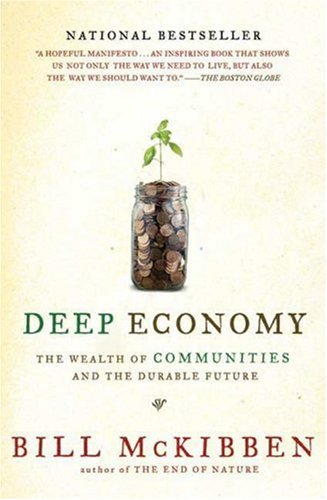
"It's extremely hard to imagine a world substantially different from the one we know. But our current economies are changing the physical world in horrifying ways. It's our greatest challenge - the only real question of our time - to see whether we can transform those economies enough to prevent some damage and to help us cope with what we can't prevent. To see if we can manage to mobilize the wealth of our communities to make the transition tolerable, even sweet, instead of tragic."It provides the dichotomy we all - each of the four authors and those that provide discussion - stumble around. On one hand, the actions of 6 billion people on Earth are harming the land we walk on, the air we breath, the food we eat, the water we drink, the economies that provide a standard of living, and the communities we grow in. On the other hand, the actions of 6 billion people on Earth provide some shelter to live in, clean air in some locations to breath, food to some, clean enough water to drink, economies that provide a good standard of living to some, and moderately stable communities to live in.
The tragedy of this dichotomy can be stated two fold. First, that the total community of 6 billion people, with combined wealth and effort, are incapable of fulfilling basic requirements of living to all its people. Or second, that the total community of 6 billion people, with combined wealth and effort, are unwilling of fulfilling basic requirements of living to all its people.
It is a sad story and while I did not necessarily set this post up as a debate, I hope that it provides a context for the discussions we have had or are going to have. When reading through the comments directed at whether there is an issue (e.g. climate change) or what to do about it (e.g. environment, economy, etc.), the arguments for inaction or action are normally the same.
A persons cultural values (e.g. racism), religious values (e.g. evangelical), economic standing (e.g. upper class), familial upbringing (e.g. broken home), political leanings (e.g. liberal), educational status (e.g. Professor), and living environment (e.g. inner city) all are given as fundamental reasons why or why not issues should be dealt with. It seems that, often times, we stray from the underpinning reasons for the things we, as communities, do (e.g. providing housing, jobs, food, health care, etc.). Empirically, it comes down to our capability or willingness to act, nothing less and nothing more.
On climate change, where do you fall? Poverty? Financial deregulation? Federal funding of basic research and development? Abortion? Gay marriage? Universal health care? Foreign aid?
Saturday, August 30, 2008
Deep Economy
Just started reading a book called Deep Economy by Bill McKibben. While I intend to write a full review once I finish it, it brings up an intriguing question:
Should our economy (and therefore society) strive for growth as its central economic policy or should it focus on locally driven prosperity?
I don't necessarily believe the two are directly tied to one another - as our economy grows, our people prosper. It seems we have surpassed some type of tipping point, where "more" does not mean "better". More so, "more" no longer means increased happiness like it once did.
An example - the U.S. economy grew by 3.3% (as a whole) in the last quarter, even as people lost their homes, unemployment grew, income decreased, fuel prices increased, and food prices increased. The economy has also become the central issue in our next round of elections, even with growth, tax breaks, and rebate checks.
Has the economic theory of Adam Smith become less relevant as we move into another era in history?
