Showing posts with label environment. Show all posts

Saturday, January 18, 2014

CLIMATE CHANGE - UNIVERSITY OF EXETER - Week 1

Even though I've been teaching about climate change for 15 years, there's still a lot of the science I don't fully understand, and I'm also always looking for ideas on how best to communicate complicated ideas about the environment to my undergraduate students, and how to engage them more fully in learning. So I happened across this link to Future Learn an on-line learning consortium of British universities, and in particular to an undergraduate oriented course on climate change. It's eight weeks long, free, and so far seems quite engaging.  This is not my first on-line learning experience (I also teach mostly on-line classes) but it is my first experience with a MOOC, and with a course that has such high production values. 

One of the things that we are encouraged to do in this course is to use a blog to engage in "reflective learning." At first I thought about creating a whole new blog, but that seemed redundant given that Blue Island Almanack was just sitting here unused for the past four years. So here I am!

Week 1 covered a lot of basic material. So I was surprised to find that there were a number of things that were new to me, or that I understood better by the end of  the week than previously because of the skill with which they had been explained. 

The first little surprise was the explanation for why "greenhouse" is not the best analogy for how our atmosphere holds heat. The glass of a literal greenhouse does not prevent long wave (heat) radiation from leaving the greenhouse.  This was new to me, simplistic explanations given to me years ago said that the glass prevented the heat from escaping, turns out that is not quite correct. Long wave (heat) radiation does escape through greenhouse single pane glass. However, the glass does provide a physical barrier to wind that would remove heat by convection. This makes so much sense to me - I spent two summers of my life (1970 and 1971) working in greenhouses planting and taking cuttings from chrysanthemum plants, and know what the heat of a greenhouse is like. 

A better analogy for how the earth's atmosphere retains heat is NASA's temperature regulating blankets . This high tech blanket is embedded "millions of invisible microcapsules that absorb excess heat when you are hot and release the stored heat when you are cold, ensuring a comfortable temperature and humidity." In the earth's atmosphere the "microcapsules" that absorb and release heat are molecules of the various greenhouse gases: water vapor, carbon dioxide, methane, ozone, CFC's and nitrous oxide. Which brings up another new factor I encountered this week: I'd never heard water vapor called a "greenhouse" gas previously. It is different from the other greenhouse gases listed, because it changes in concentration as temperature changes. Water vapor does absorb and release heat, but water vapor increases when temperature increases and decreases when temperature decreases, so it is an important feedback greenhouse gas, but not a "forcing" gas that changes concentration due to non-climatic events. 

The most interesting thing I got from this week was this diagram that helped me understand several important aspects of our atmosphere and how it promotes life and affects climate. 
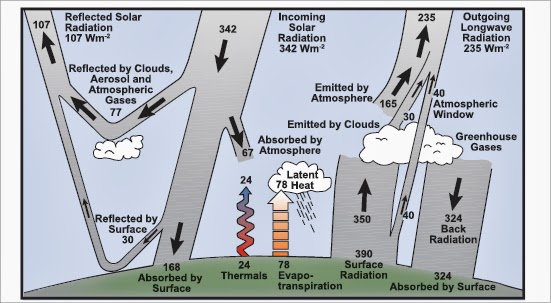

FAQ 1.1, Figure 1. Estimate of the Earth’s annual and global mean energy balance. Over the long term, the amount of incoming solar radiation absorbed by the Earth and atmosphere is balanced by the Earth and atmosphere releasing the same amount of outgoing longwave radiation. About half of the incoming solar radiation is absorbed by the Earth’s surface. This energy is transferred to the atmosphere by warming the air in contact with the surface (thermals), by evapotranspiration and by longwave radiation that is absorbed by clouds and greenhouse gases. The atmosphere in turn radiates longwave energy back to Earth as well as out to space. Source: Kiehl and Trenberth (1997). URL: http://www.ipcc.ch/publications_and_data/ar4/wg1/en/faq-1-1.html

The nature of energy exchange is that for every watt of energy that comes in from the sun (342 Watts per square meter) an equal number of Watts energy (325 + 107 = 342 Watts per square meter) must be radiated back into space. If all that energy came in and went out directly the surface of the earth would average a temperature of -19 degrees Celsius, which is obviously too cold for human (or most other type of) life.  What happens is that greenhouse gasses (listed above but especially water vapor and secondarily carbon dioxide) absorb the heat for a while and bounce it back into the atmosphere. This bounced back radiation called logically "Back Radiation" is crucial for making life livable. The heat gets to bounce around for a while longer, raising the temperature of the atmosphere near the surface to an average of 14 or 15 degrees Celsius - a much more hospitable climate.  Ultimate all that heat energy does leave and the total amount emitted does equal the amount that comes in from the sun, but there is this time delay, allows the lower atmosphere to reach a warmer temperature.  The upper atmosphere where the final heat exchange does occur is -19 degrees Celsius. 

Suddenly it all makes sense!

The other thing that really helped me this week was some nice organizing lists that helped me order some information that I already had.  The Radiation Balance of the Earth is the equation that looks at all the factors found in that diagram above - how much energy comes in, how much is reflected, how much is absorbed, how much crucial back radiation there is and of course how much is ultimately radiated back to space. While it is always true that the ultimate amount radiated back to space must equal the incoming solar amount, the proportions that are reflected, absorbed by the surface and Back radiation can vary. 

There are three fundamental ways to alter the complex equation that is the radiation balance of the earth. First factor, the amount of radiation in coming from the sun can change. This is due to two things: a) changes in the sun itself that affect the sun's energy output and b) changes in the earth's axis tilt and orbit around the sun which affect the time and angle at which sunlight strikes the earth. Second factor is changes in albedo or reflectiveness of the earth - how much of the sun's short wave radiation (light, ultraviolet, etc.) is reflected back before it can warm the earth's surface. Things that change albedo are: the amount of surface covered by ice and snow (highly reflective), the amount of vegetation on the surface (a forest reflects less than a desert), the amount of cloud cover (tops of clouds reflect light back), and the amount of particulates and aerosols in the air - the more aerosols the greater the reflectivity (particulates and aerosols can be naturally occurring from volcanoes, or man-made from smokestacks and car exhausts). The third factor concerns the altering of long wave (heat) radiation patterns, changes that affect the amount of heat immediately radiated into space versus the amount of Back Radiation there is - the amount of heat held and returned to the atmosphere for a while before it is ultimately dissipated into space. The third factor is affected by the chemical composition of the atmosphere, such as changes in water vapor, carbon dioxide, methane, ozone, CFC's and nitrous oxide. 

I knew all those things, but that's a nice organizing schemata!

Saturday, May 22, 2010

Obama blames Gulf oil disaster on breakdown at BP | Reuters

Below is one of today's headlines from Reuters, and a link to the article. Unfortunately, the President is 100 percent wrong. What happened at BP was not any type of "breakdown", but an example the way capitalism works without genuine government regulation and oversight. This is not an example of "bad people" but of a a flawed system.

Businesses in a pure "ideal" capitalist economy are beholden to their owners only and to required to produce profit for their owners. Period. Businesses are not beholden to the public, to their customers (except to the extent that they need customers to make a profit for their owners), and most especially businesses are not beholden to "the environment" or to the human species. The only thing that can change this is "interference" by government, in the form of laws and regulations, regular inspections and oversight, and fines, penalties, and in extreme cases shutting down operations when laws and regulations are not followed.

If our government does not provide this type of "interference" there is no reason on earth for a manager or executive in any business to spend money for safety measures, tests and retest, safety equipment, etc. The logic of a capitalist business is to cut costs wherever costs can be cut, to produce the greatest profit possible.


Obama blames Gulf oil disaster on breakdown at BP | Reuters


Photo: Bands of oil are seen near the site of the Deepwater Horizon oil spill in the Gulf of Mexico off the coast of Louisiana May 21, 2010. Photo Credit: REUTERS/Lee Celano

Thursday, December 17, 2009

seeing beauty versus photographing it


I live in a beautiful place. There is certainly some ugliness -- mostly in the form of strip-mines, but also a lot of litter on the road sides -- but overall this is a beautiful place. Hills and mountains close in around the narrow valleys and hollers, where communities form like Christmas lights strung along the creeks and streams, and narrow ribbons of asphalt thread among the houses.

Every day, as I drive to and from work, or go out to run errands and go shopping, I see beautiful, inspiring scenes that make my heart sing with joy. Yet when I contemplate photographing this beauty I run up against rarely discussed, yet nonetheless existing "rules" about what makes a beautiful photograph.

For example, electrical wires, light poles, transformers, and other such things are not suppose to "mar" a beautiful photograph of nature. Yet, almost every view I have of the mountains, forest and sky has such things within it. Over the last several years, as I've done more and more photography, I've thought a lot about this.


The human eye in daily life, looks past things like wires and poles, street lights and traffic, and is inspired by the natural landscape beyond them. In our minds we edit out these things, they do not distract us from the view. But the literal eye of the camera locks these trappings of modern industrial society into view, creating images that do not conform to social conventions of natural beauty.

Some man-made objects are acceptable in nature photographs -- the older the better! Old barns, old fences (at least wooden ones), old houses, antique cars (not your old rusted clunker on cinder blocks), old wagons, old tools hand tools (not old rusting mining equipment!). But the kinds of man-made structures (untidy utility poles, trailers and double-wides, pick-up trucks, gas stations and Dollar General Stores) that often end up in one's view around here don't qualify as acceptable backdrops or foregrounds for nature photography.

The biggest problem with this disparity between people's daily experience of nature, and social standards for natural beauty as represented by nature photography, is that it can lead to degradation of the environment. Places like this are often viewed by those with the power to make such decisions as not beautiful or scenic enough to be worth saving.

Between 1976 and 1982 as I did the research for my masters thesis and doctoral dissertation in the nearby mountains of southwest Virginia, I observed a distressing scenario unfold. The United States Forest Service was developing the Mount Rogers National Recreation Area and had selected the theme "Rural Americana" for their development. To achieve the idyllic rural vistas that the Forest Service desired for tourists, they decided it was necessary to obliterate several existing rural communities, such as Fairwood, condemning property through eminent domain and bull-dozing homes and outbuildings. Real rural Americans were "rural" enough for the Forest Service.

It is this type of mindset that also leads decision-makers to say, "what's one more strip-mine?" in eastern Kentucky? How can it matter to anyone whether yet another mountain top gets denuded of forest and turned into rubble. But it does matter.

I live in a beautiful place -- for now.

Wednesday, September 30, 2009

Friends of Coal


There is a sociologically and politically interesting phenomenon sweeping the coal fields of Kentucky (similar things are happening is West Virginia) called the Friends of Coal.

Friends of Coal is the brainchild of a coal industry organization Kentucky Coal [note the nearly identical websites]. The Kentucky Coal Association central membership is coal companies and associate members comprised of businesses related to coal mining such as engineering firms, equipment firms, (even law firms) and individuals employed in the coal mining and related industries.

Friends of coal began as an exercise in what political pundits call "AstroTurfing" -- industry sponsored and supported activity posing as grassroots organizing -- but it has become a genuinely popular organization garnering membership, support and funding from thousands of Kentuckians from all walks of life. This may be a political first, a popular movement in support of a particular industry, not by its workers, but by a wide cross section of individuals and families living within the communities where an industry operates.

Not only does one see the bumper stickers, window stickers, yard signs, pins and t-shirts declaring "Friends of Coal" in eastern Kentucky. But most intriguingly, the Friends of Coal organization proposed a special issue Kentucky license plate (see photo at top taken at a stop light in Letcher County), which has been wildly successful and can be seen on cars (and especially trucks) everywhere in eastern Kentucky.

This may be the first time in the United States that an industry actively engaged in whole series of major political battles (over the regulation of carbon dioxide emissions, mountain top removal, and fly ash storage) has been able to get the general public to voluntarily help fund their public relations battle through a official state sponsored tax (license plate fees). Usually industries have to use their own monies (albeit coming from customers) for legitimation advertising and activities.

The average person in eastern Kentucky who sports a "Friends of Coal" sticker or license plate views supporting "the coal industry" as identical to supporting "coal miners." A view which flies in the face of the very long record of industry abuses of the health and safety of miners, and successful efforts to undermine unionization of coal mining.


Supporters of Friends of Coal fear that new environmental regulations will bring a sudden and abrupt end to all coal employment in the mountains. They lack awareness that the coal industry has done quite well on its own to cut coal mining employment despite many decades of special treatment and tax advantages from the Commonwealth of Kentucky. Employment in coal in Kentucky has dropped by two-thirds from a high of about 48,000 in 1981 to 17,893 in 2006. [graphic from MACED based on data from CoalEducation.org].

Wednesday, June 3, 2009

trying to be a good environmental citizen

Twelve and a half years ago our region suffered a destructive mid-winter snow and ice storm that knocked out power to a wide area for three days. It was our first winter in our house and our only alternative source of heat was an open fire place. It kept us from freezing, but it was a very unpleasant three days. So early the next fall we invested in a large size kerosene heater and a five gallon drum of kerosene.

However, we did not have another winter time power outage until this year, which lasted two days, but they were unseasonably warm days despite being in February, and we only needed the fireplace in the evening to take off the chill. So here we are twelve years later with five gallons of kerosene which have taken on moisture and gone bad, and cannot be safely burned in our kerosene heater.

I started calling all over our county trying to find someone who would accept kerosene for environmentally sound disposal. Everyone was very quick to say "no" -- some even vehemently, including the major distributor of kerosene in the area. I got discouraged and stopped searching for a while.

Last week, I decided to try the web, and ended up with Kentucky's state department of hazardous waste. I sent an e-mail, and got a quick response telling me that they would refer me to the regional hazardous waste office. Two days later, I got an informative e-mail from the regional office. The regional official said that "most" places that accept used motor oil will also accept kerosene, and he provided me a list with phone numbers of four or five locations within 40 miles of my home that accepted motor oil. I called all of them and each of them said, in no uncertain terms "NO," they only accept used motor oil, and would not accept kerosene.

One person I talked to suggested that I use the kerosene up by burning brush on my property. [First I don't have that much brush, and second we try to leave brush in place to provide habitat for wild critters.]

Back, by e-mail, to my regional office. The response was quick and informative -- kerosene can be disposed of in a properly contained landfill, but only after it is "solidified" by mixing it with something like kitty litter, and leaving it open to the air to evaporate. Only when it is totally dry can you dispose of it, and only in properly lined and sealed landfill. Since I am not yet certain we have one of those, I'm still not certain whether I will be able to dispose of my ancient and contaminated kerosene.

The point of my narrative is this: how can citizens be the solution and act in environmentally responsible ways with toxic wastes if there is no one within any reasonable travel distance who will accept those wastes? I now have at least a smidgen more sympathy for the local oil distribution company that has just been stacking old diesel fuel tanks on an empty lot -- with the not too unexpected outcome of leakage into the regional water supply.

Monday, May 4, 2009

Take a hike (and fix-up a trail)

National Trails Day is just over a month away. On Saturday, June 6, organizations all over the country will be working to build and maintain hiking and biking trails, and trail shelters along the way. Scout troupes, conservation groups, state and local governments, the National Park Service, and hiking clubs are looking for individuals and groups interested in serving their communities.
As someone who has volunteered with this sort of work in the past, I can tell you that it's tough but rewarding. Perhaps the most important outcome of doing this is the sense of ownership that trail stewards develop as a result of taking brief responsibility for a piece of land that lots of people enjoy. Jones Mountain Cabin, in the wilds of Shenandoah National Park, seems like an old friend after that long weekend of cleaning out the fireplace, replacing the railings on the front porch, and maintaining the hand tools. There was a lot of hiking, eating, drinking 50 degree spring water, and playing music too, that June weekend. (This image more likely pictures October.)
Many trail clubs and other organizations leading Trail Service Day events accept volunteers with no experience. And (unlike the 2.5 day event I mentioned), most of these service events simply run from the morning to around lunchtime. However, if you have serious landscaping or construction experience, some groups also have projects for those looking for something more involved.
If you're interested in pitching-in, the American Hiking Society offers an event finder:
http://www.americanhiking.org/NTD.aspx

Image: Jones Mountain Cabin, Shenandoah National Park, VA, shamelessly ripped-off from some hiker's flickr page

Thursday, April 23, 2009

Earth Month irony

Here it is April, Earth Month, and this blogger has been silent for weeks. What gives? No, E.R. Dunhill has not been afflicted by white-nose syndrome as a result of installing a bat-box (just so there’s no confusion, that’s a joke, not an actual risk to people), nor have I fallen into my new composter.
Like a lot of committed environmentalists, I’ve just been über busy. I’ve been up to my beard in getting ready for an Earth Day event, developing and delivering a Sunday school class on green ministry, writing a term paper (on oxidative enhancement of bioremediation, using Oxygen Release Compound, since you asked), and taking some steps toward getting my yard set-up as a wildlife habitat. Now that the light at the end of the tunnel is coming into view, I’ll have an opportunity to take a breather and blog a little about some these activities. (And yes, Honey, I'll plant the herbs and vegetables.)
For the moment, I’d like to wish everyone a happy and productive Earth Month. Keep at it- we’re in this together.

Friday, March 20, 2009

It's like watching MacGyver work

It's not really. It's a brick. Or, it's a jar, or something else that displaces water. You've no doubt heard it before, and many readers are already doing it. However, for those who have never encountered this eons-old water conservation measure:
You can convert just about any existing toilet into a low-flow unit without ever getting your hands dirty*. Booting-up your computer probably takes longer than this will.
Simply take the lid off the tank, and place a brick, a concrete paver, or a clean jar (filled with water and tightly closed), and put the lid back onto the tank. Done.
Now, every time the tank refills, the brick (or whatever you've used) will displace some water. The result is that every time the toilet is flushed, it uses that much less water. Depending upon your home's usage and how much water you can effectively displace, this can easily save gallons every week. For reference, it you use a spent 20 oz soda bottle to displace water, that translates to about a 10% savings for many units.
This saves you and your community water and energy. Keep in mind that in virtually every US home, all of the water entering the house is potable water. That means that it has been thoroughly treated to the point of being safe to drink. And, of course, it must be pumped (both treating the water and moving it require energy) before it gets to every fixture in the house, even if that fixture is only used for washing clothes, spraying-off a lawn mower, or flushing a toilet. You're paying for drinking water for all of those uses. And, of course all of that wastewater has to be treated after it leaves your home. You pay for that, too.
Save some water, save some money.

*Author's note: Since this post specifically names bricks (which are often dusty or dirty) and jars (which have to be thoroughly cleaned), E.R. Dunhill's statement that you will never get your hands dirty is probably patently untrue. Also, the author would have written the usual emphatic Be the solution in this post, but as quick as the actual recommendation is, it seemed like a waste of time. Nuts. I've just written it.

Wednesday, March 18, 2009

It’s kind of like ZipCar for books

Remember libraries? They’re like book stores, only you don’t pay for the books, and no one minds if you just sit around and read without taking anything home. (Remember book stores? They're like Amazon.com, but with other people.)
Libraries are regaining their relevance, after an inevitable ebb. With so many regional and local economies suffering, free opportunities for recreation and no-cost access to information to hone skills and find jobs are important. While it may not be immediately obivous, they’re a great place to interact with real, live people. (Take that, Internet!) Libraries also offer the benefits of group ownership: I can read the book, my neighbor can read the book, my wife can read the book, and some guy named Doug can read the book- but as if by magic, it’s still just one book. It’s only manufactured once, but it’s used many times by many different people. What a creative, thrifty, and environmentally-friendly idea. It seems like something Benjamin Franklin would have dreamed up.
My local library happens to be adjacent to a few local stores, several restaurants, and (my personal favorite) an ice cream shop, all of which surround a courtyard with benches, tables, grassy areas, a fountain, and a little pavilion for performances. There’s even a movie theater and a coffee shop nearby. People meet, interact, support local businesses, read, and borrow books, all in a central place that’s about a five-minute walk from the local Metro station. It’s a wonderful and natural synthesis of public and private space, one I’d love to see replicated more.
Whether or not your local branch is as hip as mine, a library is a great way to build community, learn, and save money with minimal impact on the environment. Be the solution

Wednesday, March 11, 2009

A hurried, half-considered question to the reader

There's been a great deal written about Ponzi schemes over the last few weeks, as the case against Mr. Madoff (and potentially others) unfolds. In very brief (for those unfamiliar with Mr. Ponzi's legacy), this scheme is fraud in which a financial advisor collects money from investors, does little or nothing with it (and probably spends a lot of it), and pretends to be making a killing. The financial advisor touts his fake success to attract new investors who add new money to the scheme, thereby creating the illusion that it's actually making money. Investors believe that they'd be stupid to take their money out of a "fund" that's making so much money, so they simply keep reinvesting.
The party eventually runs out when the criminal advisor dashes-off with the money, or it becomes painfully evident that the "fund" is insolvent.
So that brings me to my hastily concocted questions to the reader:
Is a growth-only economy just a giant Ponzi scheme? Is a mindset that falsely pits economic well-being against environmental and human health a Ponzi scheme? Is reliance on increasing consumption of finite resources to run the economy a Ponzi scheme? Would a sustainable economy right the books?

Friday, March 6, 2009

The best thing since sliced bread, or Car trouble revisited

Zipcar has proved its mettle sooner than I’d anticipated. Late Sunday I learned that the following evening I’d need to attend a city council meeting and to potentially speak about an environmental award. My wife had a longstanding commitment at the school where she teaches, also on Monday.
The complications:
1. Both meetings started at the same time, which also happens to be when our son goes to bed.
2. Our son is teething, which makes him exceedingly disinclined to go to sleep.
3. We just got rid of one of our cars. The plan was that we’d sign up for ZipCar, but I just hadn’t gotten around to it yet.
4. We didn’t know this at the time, but our son was also exceedingly disinclined to go to sleep because he was coming down with the stomach flu.
There was no way I could get the ZipCard in time, but I figured that since I had a few free minutes at lunch, I’d at least go to the web site and set up an account, so it would be available for the next mini-crisis. I spent about five minutes filling out forms on the website.
Bang. Twenty minutes later, I had my ZipCard in hand. In less time than it takes to have a fast food meal, I had the power to grab a car all over (and around) DC, and several other cities should the notion take me. As it turns out, you can pick up your card from a ZipCar office moments after filling out the online forms. (You can also get the card mailed to you, but where’s the fun in that?) The entire face-to-face piece of the transaction took about two and a half minutes.
So, I got on the web, reserved my car, picked it up from the Metro station after work, did the meeting, and was back home with Junior before you can say, “Bob’s your uncle”. I got where I needed to be in a hurry, did so in a fuel-efficient vehicle, and I’m not making car payments. ZipCar’s a winner.

Wednesday, February 18, 2009

Green is the new purple

I apologize upfront for the bad joke about liturgical colors. (Sadly, I still think it’s funny.) But, it does make the point that some of the traditions of Lent blend naturally (and spiritually) with ideas for green ministry.
Many of us have known people who adopt a Lenten discipline, and some of us do this ourselves. (In brief, some Christian traditions enjoin adherents to fast, take a holiday from certain vices, or add structured reading or prayers to their daily routines during the 40 days of Lent.) Among other things, this practice is intended to exchange people’s focus on worldy things for a focus on God’s grace and the reasons we need it.
This year, I plan to participate in this tradition for the first time. However, rather than the age-old practice of giving up meat (that seems like cheating, since I’m a vegetarian), or a more contemporary discipline like parting with chocolate or TV, I plan to observe Lent by giving up disposable cups and bottles, and anything made of Styrofoam. I don’t use much of these, but I get lazy sometimes, and I think there’s a legitimate sacrifce in going from few to none.
This may at first seem a little odd, but it fits the bill for a good Lenten discipline. These are conveniences I can forgo to remind me to reflect on the coming Crucifixion and Resurrection, some of the most important principles of my religion, and arguably the most important points on the liturgical calendar. In this sense, my green discipline is no different from the traditional ones. But at the same time, this helps me to be a good steward of the natural environment and a good neighbor by producing less trash.
Some other ideas for green Lenten disciplines include:
Drink tap water instead of bottled
Adopt meat-free days each week, or go vegetarian until Easter
Abstain from driving one day per week
Avoid buying new goods (with the exception of food and other essentials)
Or serve the community directly by collecting trash and recyclables once a week at a local park or roadside

The possibilities are endless. If you’re interested in doing something green for Lent, but none of these ideas strike a chord, feel free to ask me about others.

Image source: Wikipedia

Friday, February 6, 2009

On the providence of car-trouble

It’s been a long time coming. My wife and I bought a used Pontiac Aztek years ago. We needed something to get me to and from the office, and it had to be a suitable weekend ride for our rambunctious basenji hounds. The vehicle fit our need and our young married-couple budget. From the beginning, the vehicle’s fuel economy didn’t set well with me. But, it wasn’t as bad as it could have been, and we weren’t the first owners, so I felt good about reusing an existing vehicle.
Alas, dear Aztek is about to join the departed. After this problem with the air conditioning a couple of years ago, that problem with the alternator last year, and a recent bout of overheating on a weekend trip to the Blue Ridge Mountains that ultimately resulted in a blown main gasket, it just doesn’t make sense to get it fixed.
With one of our two cars on its way out, I started considering my options: Hybrids, small conventional cars, and fuel-efficient diesel cars. I was wearing the “that’s the way we’ve always done it” blinders.
What I realized later the same day that I started researching new cars is that my family doesn’t actually need two cars. Our home is within walking distance of shops, restaurants, several parks and playgrounds, a library, and a movie theater. Moreover, we walk past (or through) a Metro station on the way to these places, where we can catch Metrorail, Amtrak, and MARC trains and Metro and Ride-on buses. And, we can pick-up a Zipcar there.
On the latter option, I find myself playing the proverbial kind in the candy store. For those unfamiliar with this grand idea, Zipcar is an updated take on renting cars. It’s also an Internet-age version of the WWII institution of car-sharing clubs, which began to help communities to conserve fuel. With a conventional rental car one goes to a rental office, fills out a bunch of forms, and gets the car for a daily rate. With Zipcar, the driver signs up for an account (once) online, and from the web can reserve a car at an hourly or daily rate. Zipcars are available all over the place- places like Metro stations, shopping centers, town centers, &c.
The benefits to the economy of my household and to the environment are several. First, I’m not adopting a car payment for a vehicle that will mostly sit in my driveway. Nor am I paying to maintain or insure said sedentary vehicle. Instead, I’m paying a comparatively miniscule amount to effectively own a tiny share of a car (a fleet of cars, really) with a large group of people. This allows me to have a second car on the rare occasion that I need one, but I'm not saddled with its expenses when I don’t.
The environment wins, too. Again, I will share a car with other people. The significant amount of energy and raw materials that go into producing the vehicle are spread out across a group. Most of the Zipcars are also small, fuel-efficient cars, with a goodly number of hybrids among them. And since the performance of the vehicles factors into their profitability, the company has a vested interest in keeping them well-tuned.
So, my wife and I are interpreting the end of our car as a blessing. Rather than complaining about environmental problems and going on with business as usual, we’re taking this opportunity to go from two cars to one. I’ll let you know how it goes.

Image sources:
National Archives and Records Administration. ARC Identifier: 516143
Zipcar

Wednesday, January 7, 2009

Religion and environment: What gives?

Many religions and many religious organizations and communities value some kind of community service, whether that be supporting soup-kitchens, alms-giving, building homes, supporting disadvantaged families, &c. The existence of organizations like the Evangelical Climate Initiative and Greater Washington Interfaith Power and Light demonstrates that believers in various faiths are beginning to recognize the connection between the natural environment and community service in a religious context. The growing list of books that focus on (or at least address) religious underpinnings of environmental action, such as Earth-Wise, God in the Wilderness, Care for Creation, This is My Father's World, A Greener Faith, and Last Child in the Woods, suggests that an increasing number of people are exploring these connections.
At the same time, the Center for Reformed Theology and Apologetics still declares that environmentalism is idolatry. Less than a year ago, evangelical leader Rich Cizik was censured for advocating that his religious community make battling climate change a priority. And, in my personal experience, I've encountered dozens of people who become furious at the suggestion that there is a religious mandate for improving environmental quality.
I call upon the reader to serve as a research assistant: Why does so much anger and opposition remain on this issue? Why do religious communities avoid adding environmental action to their portfolio of community service? Would your religious community be open to studying this issue? Why / why not?

Image Source: US National Gallery of Art

Tuesday, December 30, 2008

My name is Adam, and I am 13.7 billion years old

I’ve been spending my free time between semesters trolling scripture for a green ministry class I’m teaching this spring. Among others, I read from Genesis a couple of chapters I’ve read dozens of times and found a remarkable lesson. In the second account of creation (the one that appears in the second chapter), we find:

7 Then the LORD God formed a man from the dust of the ground and breathed into his nostrils the breath of life, and the man became a living being.

The earth’s physical attributes and every living thing we find here – past, present, or future – are inextricably connected. The surface of our planet is largely covered with water, which is full of salts, leached from rocks over the eons. Water vapor also permeates our atmosphere, which is itself mostly nitrogen, with some oxygen, carbon dioxide, ozone, argon, and other bits of this and that. Much of the solid portion of our soils (as well as the cocktail of dissolved solids in soil-water) is the result of rocks being physically and chemically picked apart.
From this nonliving environment bacteria, protists, plants, fungi, lichens, and animals build soil, fix nitrogen into chemicals useful to living things, and spin carbon dioxide and water into sugars and (with those useful nitrogen bits) proteins. We see that in a literal sense, living things, including humans are made of the nonliving “dust” of Genesis, along with the “breath of life”. We’re composed of the recycled leftovers of the begininng of the universe, squashed into stars and blown apart, squashed again into our Sun and Earth, worn ragged and perfect by relentless physcial and chemical action.
But we are not an end result. We are not the owners of all of this mineral wealth that is our physical selves. Instead, as we see in Gen 3:19, we will return all of this. Implicit in the “to dust you will return” is the macabre fact that our remains will wind through the long, slow cycles to become carbon dioxide, perhaps limestone, perhaps sea salt, and certainly part of other animals, plants, and living things so insignificant, we don’t bother to learn their names. Moreover, with every breath we take from the moment of our birth until we expire, we participate in this conversion of nonliving into living, and living into nonliving.
So what do we get out of this? Another somber reminder of mortality on the eve of a new year? No, instead we see that we’re blessed with much, but that we’re only caring for these gifts for a while. We see that we are temporary participants in creation, sharing everything with other living things, and that we are not alone in this role. Our gifts and responsibilities belong as much to our grandchildren’s grandchildren as they do to us and to our ancestors. We have a responsibility to take care of them.

Image source: Freer + Sackler Galleries

Saturday, December 27, 2008

Bee the solution -- grow a meadow

Like most Americans who pay attention to the news, especially environmental news, I had heard of "Colony Collapse Disorder" that has been killing off about one in three North American honey bee colonies each of the last several winters. However, I was not aware, until watching this TED presentation by Dennis vanEngelsdorp, the Acting State Apiarist for Pennsylvania's Department of Agriculture, was that native polinators like bumble bees, and bats, are also disappearing -- bats are disappearing at an alarming rate. The majority of fruits, vegetables and nuts we eat depend upon pollination by honey bees, so this, like all environmental problems, is a human problem and an economic problem, not just a "bee" problem. Watch, enjoy, and learn!


The most interesting and valuable suggestion that Dennis vanEngelsdorp makes in this video, is to replace your lawn (or at least part of it) with a meadow. Here's a way that ordinary citizens can be part of the solution to an environmental problem. A few years ago, I heard a speech by a horticulturalist who advocated (for a variety of environmental reasons) leaving a six to ten foot radius circle around major trees in your yard. We immediately instituted that practice in our 2/3 acre lot. There's lots of benefits of this, in addition to creating more habitat for polinators -- less time wasted on mowing the lawn, less gasoline is wasted, less noise and pollution is created, less greenhouse gases created, and many more butterflies, birds, and other wonderful creatures will find their way to your yard.

Saturday, December 20, 2008

Coal River Wind -- a better way

Coal River Mountain, West Virginia is slated by Massey Coal to become the next casualty of mountain top removal strip mining. This form of mining blasts the tops of mountains with dynamite, then hauls away tons of rock and soil, dumping this overburden in nearby valleys covering up streams and habitats. The photo on the right is Marsh Fork where some of the overburden of the projected Coal River Mountain mine will end up.

On the top left is Coal River Mountain as it looks to day, before any mining commences. The photographer is standing at the edge of an existing mountain top removal strip mine of what was once Kayford Mountain, looking southwest to Coal Mountain.
The bottom left an aerial view of what is left of Kayford Mountain, WV: an 11,000+ acre Mountaintop Removal coal mining site that sits just to the Northeast of Coal River Mountain.

A.T. Massey has already received permits that would allow them to engage in mountain top removal and valley fill operation on more than 3,000 acres of Coal River Mountain, and have two additional areas mapped, that would add and additional 3,000+ acres.

Local residents concerned about the impacts on the quality of life in their communities formed the Coal River Mountain Watch, and joined with regional and national environmental groups to suggest an alternative to mountain top removal -- a wind farm that would capitalize on the strong persistent winds on these West Virginia mountain ridges.

The coalition of groups funded a four month study of the economic potential of both the planned mountain top removal and the proposed wind farm. In sum, the study found that because the power generated by wind could continue indefinitely ("forever" as the fact sheet states), while the mine would be played out in 14 to 17 years, the proposed wind farm would generate both more energy and more dollars. Moreover,

"when externalities such as public health and environmental quality are factored in, a mountaintop removal mine ends up generating an economic LOSS of $600 million over its expected 17 year life. A wind farm on the other hand would remain profitable over the life of the wind farm. This means that when the true costs of mining are considered, the wind farm option wins hands-down." Rory McIlmoil, Coal River Wind.

The Coal River Mountain Watch and its partners are asking for support from you and others like you around the country, to generate more public awareness of the problems of mountain top removal and the possibility of economically viable, clean, renewable energy alternatives. Another goal is to create support for the national Clean Water Protection Act that would drastically restrict where the overburden from mining could be dumped, which would limit the scope of strip-mining and mountain top removal substantially. You can learn more about your own personal connection to mountain top removal and what can be done about it at I Love the Mountains.

Thursday, December 18, 2008

Regulating CO2 Emissions - a cautionary tale

Last month, November 13, 2008, to be exact, the Environmental Appeals Board of the EPA, handed down an important decision [the complete text of the decision can be read here]. The decision concerned a permit granted Deseret Power Electric Cooperative, which would have allowed construction of a new waste-coal-fired electric generating unit at Deseret’s existing Bonanza Power Plant, located near Bonanza, Utah.

In 2007, the Sierra Club presented a challenge to this permit, and sought to have it reviewed on the grounds that a) EPA's Region 8's office that granted the permit " failed to adequately consider “alternatives to the proposed facility;" and b)Region 8 failed to "apply “BACT,” or best available control technology, to limit
carbon dioxide (“CO2”) emissions from the facility." The first issue (a) was set aside and not considered by the Environmental Appeals Board. It was on the second issue that the ground breaking decision was made.

The Environmental Appeals Board determined that EPA Region 8 had inappropriately dismissed the application of a BACT (best available control technology) standard out of hand. Region 8 argued that had not imposed "a CO2 BACT limit in the Permit" because "it lacked the authority to do so."

The Environmental Appeals Board essentially said that the EPA (and EPA Region 8) DID have the authority to impose a CO2 BACT limit, and therefore must consider such a limit. The Appeal decision does not require a BACT limit to be imposed in this case, only that the reasons given (lack of authority) could not justify the lack of a BACT limit. The Appeals Board decision stated:

"Accordingly, we remand the Permit for the Region to reconsider whether or not to impose a CO2 BACT limit in light of the Agency’s discretion to interpret...what constitutes a “pollutant subject to regulation under this Act.” In remanding this Permit to the Region for reconsideration of its conclusions regarding application of BACT to limit CO2 emissions, we recognize that this is an issue of national scope that has implications far beyond this individual permitting proceeding. The Region should consider whether interested persons, as well as the Agency, would be better served by the Agency addressing the interpretation of the phrase “subject to regulation under this Act” in the context of an action of nationwide scope, rather than through this specific permitting proceeding."


This ruling recommends that the EPA to develop "best available control technology" (BACT) limits for CO2 emissions that would apply across the nation to all new construction or additions to coal fired electrical generation facilities.

But what is the "best available control technology" when it comes to limiting CO2 emissions? Although "clean coal" has been bandied about by the coal and electricity industry for several years, the actual technologies this term applies to are still for the most part on the drawing board, or deployed in small scale research settings only. Short of carbon capture, some existing technologies that reduce CO2 emissions include co-generation (of heat and electricity) or recycling, and co-firing with biomass. Simply determining the minimum possible CO2 emissions of existing highest efficiency conventional coal-fired technology is a challenge that will have to be met.

Many environmental organization and blogs hailed this decision as a triumph that would put a complete stop to permits for new coal-fired electricity generation. But the decision falls far short of that. EPA Region 8 can decide against imposing BACT limits on CO2, it just cannot use the same set of reasons (lack of jurisdiction or authority to set such limits).The Appeals board only recommends (nor requires) that Region 8 consider its decisions as part of a larger national policy. While the ruling makes the development of CO2 BACT limits more likely, the imposition of such limits on any particular new construction or expansion of an existing plant must also include considerations of economic impacts.

It could take months, or even years to establish meaningful BACT limits for CO2 emissions. Environmental Appeals Board decision does not require that all new permits for coal-fired generation wait until those limits have been established, although it certainly can be seen as recommending this action. Much will depend upon how the new Obama administration decides to respond to the Appeals Board ruling.

Friday, December 12, 2008

From crappy Pampers to happy campers

This was a tough one. I try to do my part to minimize my negative impacts on my local environment, and I make time to volunteer and undo other people's negative impacts. So every time I threw away a disposable diaper, I cringed a little. Diapers are made of plastic and paper, which means landfilling persistent waste and cutting trees. But, I cringed even more at the thought of everything you have to do with cloth diapers. I also thought about a diaper service, but this still means dealing with cloth diapers and it means the diaper van makes a couple of trips to the house every week.
As it turns out, I was dead-wrong about cloth diapers. The image that kept creeping into my head, that of trying to work origami out of a cloth square, in the dark, while wrestling with a squirming baby, is just a piece of historical fiction. Unbeknownst to me, cloth diapers had secretly become smartly designed and easy to deal with at some point in the recent past. Several vendors make fully reusable diapers, and at least one makes what I'll call "hybrid diapers" that include a disposable pad in a reusable shell. Forget big cloth squares and safety pins. The new ones are contoured, don't require a bunch of folding, and rely on Velcro.
My wife and I have been using Bum Genius diapers (one of the fully reusable types)since the baby was about 10 weeks old (he's now 9 months old), and they've been working great. They're easy to get on and off and they clean easily and completely. We haven't had any more problems with leaks than with disposable diapers. My back-of-the-envelope cost-benefit analysis tells me that we've already recouped the initial investment, even allowing for some very rough recurring costs for water and energy to keep them clean.
That said, it does take longer to change the diaper, because it has to be rinsed after use. And, once in a while, there is that moment of abject panic when I open the diaper and realize that I have to clean it. Also, this is not a solution that lends itself to being away from home for long. My wife and I still use some disposable diapers when we're out. However, we've cut our use of disposables by about 3/4.
Be aware that this involves the Fundamental Waste-Water-Energy Trade-off. When we trade a disposable product for a reusable one, this generally means that we increase our local use of water and energy to maintain the reusable product. This becomes even more confusing, when you consider all of the water and energy that goes into producing the disposable products vice the reusable one, and all of the energy (and potentially water) that goes into disposal. Of course, disposable diapers are also largely made from pulp, which is made from trees; there are some petroleum-based plastics and adhesives thrown-in for good measure...
Needless to say, a comprehensive cost-benefit analysis would be tedious and time-consuming (I might use the word "torturous"), if not impossible. So we have to use what we know about our respective situations, toss in some common sense, and make our best estimate as to whether or not this is a good choice for a particular household.
If you live in a place with water issues like Phoenix, Atlanta, or near the Ogalala Aquifer, washing lots of reusable diapers probably isn't an environmentally sound decision. In those areas, water conservation is likely a more important issue than the municipal solid waste stream. For someone like me, living on the edge of Megapolis, in an area with ample water, the reduced waste that comes with the reusable diapers is a good option.
Think about your own situation and decide whether or not this works for you. If you're not sure, ask friends who know local environmental issues, consult Google, or post some questions here.
Oh, right, "Be the solution."

Image courtesy of the author.

Friday, December 5, 2008

We Can Do It!

I’ve written before about the importance of conservation, though in many cases, I’ve assumed that its impacts go without saying. I recently ran across a simple analysis that may help me to articulate why I see energy (and other resource conservation) as the crux of an energy solution, rather than icing on the cake.
Consider the example of an incandescent light bulb in a lamp in your home, powered by electricity from a coal-fired power plant. This is a typical, though somewhat simplified scenario:
Coal is a source of chemical energy. Converted to thermal energy (heat) in a furnace, we lose about 15 percent of its energy to inefficiency, limitations of insulation, moving fluids and fuel, &c. We convert this thermal energy to mechanical energy by means of a turbine that loses more than half of the remaining energy overcoming friction and other impediments. The generator loses another 5 percent, while transmission, distribution, and grid congestion claim almost 10 percent more. The bulb itself converts electricity to light with about 5 percent efficiency (95 percent of the energy is wasted). The end result is that the light from the bulb represents a more than 98 percent loss of energy from the original coal. Put another way, every unit of light energy saved conserves 60 times as much chemical energy in the form of coal. That doesn’t include the energy spent mining, processing, and transporting the coal to the power plant, nor disposing of the 1000 tons of waste that a medium-size coal-fired plant produces in a day.
It turns out that Mom was right. We really should turn out the lights when we leave the room. Evidently, it actually conserves about 60 times more energy than it seems to. How’s that for an easy way to be the solution?

Image source: Victoria & Albert Museum