
I live in a beautiful place. There is certainly some ugliness -- mostly in the form of strip-mines, but also a lot of litter on the road sides -- but overall this is a beautiful place. Hills and mountains close in around the narrow valleys and hollers, where communities form like Christmas lights strung along the creeks and streams, and narrow ribbons of asphalt thread among the houses.
Every day, as I drive to and from work, or go out to run errands and go shopping, I see beautiful, inspiring scenes that make my heart sing with joy. Yet when I contemplate photographing this beauty I run up against rarely discussed, yet nonetheless existing "rules" about what makes a beautiful photograph.
For example, electrical wires, light poles, transformers, and other such things are not suppose to "mar" a beautiful photograph of nature. Yet, almost every view I have of the mountains, forest and sky has such things within it. Over the last several years, as I've done more and more photography, I've thought a lot about this.
The human eye in daily life, looks past things like wires and poles, street lights and traffic, and is inspired by the natural landscape beyond them. In our minds we edit out these things, they do not distract us from the view. But the literal eye of the camera locks these trappings of modern industrial society into view, creating images that do not conform to social conventions of natural beauty.
Some man-made objects are acceptable in nature photographs -- the older the better! Old barns, old fences (at least wooden ones), old houses, antique cars (not your old rusted clunker on cinder blocks), old wagons, old tools hand tools (not old rusting mining equipment!). But the kinds of man-made structures (untidy utility poles, trailers and double-wides, pick-up trucks, gas stations and Dollar General Stores) that often end up in one's view around here don't qualify as acceptable backdrops or foregrounds for nature photography.
The biggest problem with this disparity between people's daily experience of nature, and social standards for natural beauty as represented by nature photography, is that it can lead to degradation of the environment. Places like this are often viewed by those with the power to make such decisions as not beautiful or scenic enough to be worth saving.
Between 1976 and 1982 as I did the research for my masters thesis and doctoral dissertation in the nearby mountains of southwest Virginia, I observed a distressing scenario unfold. The United States Forest Service was developing the Mount Rogers National Recreation Area and had selected the theme "Rural Americana" for their development. To achieve the idyllic rural vistas that the Forest Service desired for tourists, they decided it was necessary to obliterate several existing rural communities, such as Fairwood, condemning property through eminent domain and bull-dozing homes and outbuildings. Real rural Americans were "rural" enough for the Forest Service.
It is this type of mindset that also leads decision-makers to say, "what's one more strip-mine?" in eastern Kentucky? How can it matter to anyone whether yet another mountain top gets denuded of forest and turned into rubble. But it does matter.
I live in a beautiful place -- for now.
Showing posts with label values. Show all posts
Showing posts with label values. Show all posts
Thursday, December 17, 2009
seeing beauty versus photographing it


Sunday, October 5, 2008
A Tragedy of the Community
The Blue Island Almanack represents an intersection of different views, disciplines, and issues. The central theme - Earth - may be the only common characteristic that unarguably binds us all. With this in mind, I provide the final paragraph of the book "Deep Economy" by Bill McKibben.
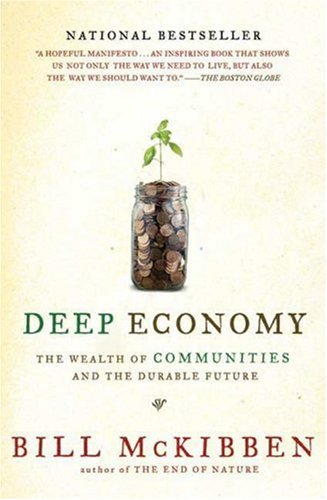
"It's extremely hard to imagine a world substantially different from the one we know. But our current economies are changing the physical world in horrifying ways. It's our greatest challenge - the only real question of our time - to see whether we can transform those economies enough to prevent some damage and to help us cope with what we can't prevent. To see if we can manage to mobilize the wealth of our communities to make the transition tolerable, even sweet, instead of tragic."It provides the dichotomy we all - each of the four authors and those that provide discussion - stumble around. On one hand, the actions of 6 billion people on Earth are harming the land we walk on, the air we breath, the food we eat, the water we drink, the economies that provide a standard of living, and the communities we grow in. On the other hand, the actions of 6 billion people on Earth provide some shelter to live in, clean air in some locations to breath, food to some, clean enough water to drink, economies that provide a good standard of living to some, and moderately stable communities to live in.
The tragedy of this dichotomy can be stated two fold. First, that the total community of 6 billion people, with combined wealth and effort, are incapable of fulfilling basic requirements of living to all its people. Or second, that the total community of 6 billion people, with combined wealth and effort, are unwilling of fulfilling basic requirements of living to all its people.
It is a sad story and while I did not necessarily set this post up as a debate, I hope that it provides a context for the discussions we have had or are going to have. When reading through the comments directed at whether there is an issue (e.g. climate change) or what to do about it (e.g. environment, economy, etc.), the arguments for inaction or action are normally the same.
A persons cultural values (e.g. racism), religious values (e.g. evangelical), economic standing (e.g. upper class), familial upbringing (e.g. broken home), political leanings (e.g. liberal), educational status (e.g. Professor), and living environment (e.g. inner city) all are given as fundamental reasons why or why not issues should be dealt with. It seems that, often times, we stray from the underpinning reasons for the things we, as communities, do (e.g. providing housing, jobs, food, health care, etc.). Empirically, it comes down to our capability or willingness to act, nothing less and nothing more.
On climate change, where do you fall? Poverty? Financial deregulation? Federal funding of basic research and development? Abortion? Gay marriage? Universal health care? Foreign aid?
Subscribe to:
Posts (Atom)
