The Blue Island Almanack represents an intersection of different views, disciplines, and issues. The central theme - Earth - may be the only common characteristic that unarguably binds us all. With this in mind, I provide the final paragraph of the book "Deep Economy" by Bill McKibben.
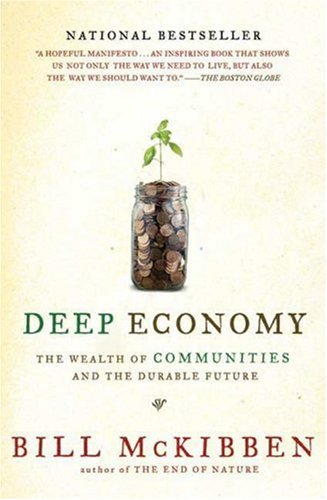
"It's extremely hard to imagine a world substantially different from the one we know. But our current economies are changing the physical world in horrifying ways. It's our greatest challenge - the only real question of our time - to see whether we can transform those economies enough to prevent some damage and to help us cope with what we can't prevent. To see if we can manage to mobilize the wealth of our communities to make the transition tolerable, even sweet, instead of tragic."It provides the dichotomy we all - each of the four authors and those that provide discussion - stumble around. On one hand, the actions of 6 billion people on Earth are harming the land we walk on, the air we breath, the food we eat, the water we drink, the economies that provide a standard of living, and the communities we grow in. On the other hand, the actions of 6 billion people on Earth provide some shelter to live in, clean air in some locations to breath, food to some, clean enough water to drink, economies that provide a good standard of living to some, and moderately stable communities to live in.
The tragedy of this dichotomy can be stated two fold. First, that the total community of 6 billion people, with combined wealth and effort, are incapable of fulfilling basic requirements of living to all its people. Or second, that the total community of 6 billion people, with combined wealth and effort, are unwilling of fulfilling basic requirements of living to all its people.
It is a sad story and while I did not necessarily set this post up as a debate, I hope that it provides a context for the discussions we have had or are going to have. When reading through the comments directed at whether there is an issue (e.g. climate change) or what to do about it (e.g. environment, economy, etc.), the arguments for inaction or action are normally the same.
A persons cultural values (e.g. racism), religious values (e.g. evangelical), economic standing (e.g. upper class), familial upbringing (e.g. broken home), political leanings (e.g. liberal), educational status (e.g. Professor), and living environment (e.g. inner city) all are given as fundamental reasons why or why not issues should be dealt with. It seems that, often times, we stray from the underpinning reasons for the things we, as communities, do (e.g. providing housing, jobs, food, health care, etc.). Empirically, it comes down to our capability or willingness to act, nothing less and nothing more.
On climate change, where do you fall? Poverty? Financial deregulation? Federal funding of basic research and development? Abortion? Gay marriage? Universal health care? Foreign aid?


