I remember a few summer ago, sitting at a table eating breakfast with a group of Ph.D's before a day of talks from science policy professionals. I was the only undergraduate student present and largely remained quiet, choosing to listen and learn. In this particular morning I was feeling a little spirited and began a discussion on where and how society needs to move forward. I presented my opinion that some sort of radical movement needs to occur in order to truly mitigate climate change, make the economy more just, and so forth. The looks I received were, at the time, terrifying to me. They were followed by a backlash of how naive I was, in much the same, stuffy, elite tone of voice that should be expected of upper echelon academics.
I'll never forget that moment. Fast forward to what has occurred since then and I wish I could see them all to smile and say, "told ya so."
It seems to me and a growing number of other (well respected) thinkers, that the United States is on the cusp of a new, progressive movement. This movement began at the grassroots level and manifested itself in the netroots. It continued at the local government level as voters looked past the superficial arguments (see previous post) and started voting for progressive candidates in both primary and general elections. More and more candidates and issues oriented groups have continued the discussion on corporate greed, climate change, an unjust economy, and universal health care. A wave of progressive thinkers are beginning to fill the halls of our policy making institutions.
Coupled with an unpopular war, financial meltdown, housing crisis, credit crunch, and increasingly negative natural disasters, many in the U.S. who previously were "unwilling" to act are saying enough. An uprising has been born.
The public trust in both the private and governmental sector are at record lows. Polls show wide agreement on the need for action on a suite of issues that have been unattended to for well over a decade. Jobs are being lost, retirement accounts purged, and debt is skyrocketing, so voters are say enough of the politics as usual - this year is different.
The tragedy of the community - where broad, yet important issues have gone largely untouched due to large swaths of the population being unwilling to act - is gaining attention. Comparable uprisings occurred in much the same manner in 1932 and 1980 - bringing about long lasting changes to both liberal and conservative ideologies, so this isn't a new phenomenon.
As the media solely focuses on the Presidential election, it is important to note that the U.S.'s citizens are speaking...albeit finally. So, while the result of the election is far from certain, there are greater forces at work here. Incumbent politicians aren't safe. Corporate bosses won't be given a free ride. Important issues will no longer be brushed aside for political gamesmanship. Bill McKibben pointed out the need to mobilize the communities to move the country and world forward and it looks like it may be coming soon.
Tuesday, October 14, 2008
A Tragedy of the Community: An Uprising


Friday, October 10, 2008
Wolf pack
 OK, that was a dirty trick. This has nothing to do with wolves and everything to do with packs. I simply wrote “wolf”, because they’re inherently cool, like ninjas, spy-planes, and most dinosaurs*.
Unless you’ve been living on Mars, under a rock, with your eyes closed and your fingers in your ears, you’re aware that those plastic bags that they hand out- well basically everywhere- clutter roadsides, streams, and parks, get stuck in trees, and fill landfills. You may have also heard that some cities and communities are so tired of dealing with them that they’re banning them from grocery stores and drugstores. IKEA and other retailers have begun charging for them, while others plan to discontinue using them altogether. Be the solution. You, the clever Blue Island Almanack reader, can sidestep all of this bureaucratic mayhem, duck the recurring charges, and reduce the stream of trash moving into landfills and everywhere else by carrying your own bag.
Skirts, you’re way ahead of me on this one. Cats, fear not: I’m not talking about toting the ridiculous “European men’s carryall” of Seinfeld and Friends fame. Lots of vendors offer backpacks, rucksacks, knapsacks, and courier bags that are amply manly. (If you’re still a little worried, you can grow out your beard, talk loudly about contact sports, or smoke a Stogie or a pipe while you carry it.) You can compound your positive impacts by buying your reusable bag from a vendor that offers environmentally-friendly or fair-trade models.
In addition to carrying any carefully chosen odds-and-ends you buy while you’re out, this is a great way to bring along your other reusables: your Ka-Bar hobo set (or titanium spork, or lacquered chopsticks), your travel mug or water bottle, and your cloth napkin.
When you inevitably become the owner of a plastic bag or two, remember that they can be reused and recycled.
*Author's note: Leptoceratops is an example of a tragically uncool dinosaur.
Image sources:
US Fish and Wildlife Service
Simple Shoes
Wednesday, October 8, 2008
Seeds
 I wrote some time ago about the beginnings of a green ministry at my church and promised that I’d address this again in the future. On Saturday, this green ministry quietly began, as I led a group of 17 volunteers on a seed collection in suburban Maryland. The ministry will officially kick-off in the spring, with a four-week Sunday school class on stewardship beginning Earth Day Sunday and with more events. We’ll focus on learning about and showing appreciation for our gifts and we’ll work to serve others.
For now, I’m finding kindred spirits in the congregation and building interest and buzz. I’m connecting the dots that working for a healthy environment is among Christians’ responsibilities: The Father gave His people this duty in Genesis. Beyond this, we should take care of a gift for which we are grateful, especially a gift in which the Maker has expressed such pride. Moving ahead to the teachings of Christ, we see a charge to care for the physical needs of others. This weekend, we put this theology into practice. In two hours, we learned about watersheds and native trees, and served our community by collecting seeds that will soon become seedlings. These seedlings will grow to become trees, perhaps part of a new forest. They will make for cleaner streams and rivers, improve drinking-water quality, feed and shelter local wildlife, and support the men and women who earn a living harvesting crabs and oysters in the Chesapeake Bay. Not bad for two hours spent with friends on a beautiful fall day.
Tuesday, October 7, 2008
just an observation
One year ago, on October 9, 2008, the New York Stock Exchange -- Dow Jones Industrial Average reached its all time high closing price of 14,164.53.
Today, the New York Stock Exchange closed at 9,447.11, a decline of 4,717.42 points in one year, or a loss of 33.3 percent – one third of its value over the past year!
Sunday, October 5, 2008
A Tragedy of the Community
The Blue Island Almanack represents an intersection of different views, disciplines, and issues. The central theme - Earth - may be the only common characteristic that unarguably binds us all. With this in mind, I provide the final paragraph of the book "Deep Economy" by Bill McKibben.
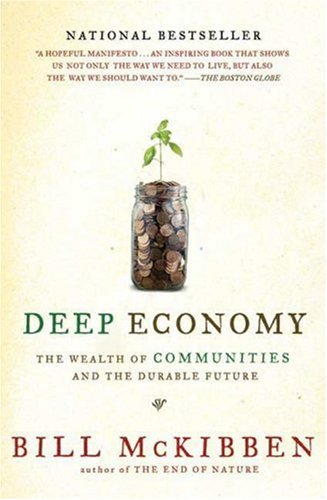
"It's extremely hard to imagine a world substantially different from the one we know. But our current economies are changing the physical world in horrifying ways. It's our greatest challenge - the only real question of our time - to see whether we can transform those economies enough to prevent some damage and to help us cope with what we can't prevent. To see if we can manage to mobilize the wealth of our communities to make the transition tolerable, even sweet, instead of tragic."It provides the dichotomy we all - each of the four authors and those that provide discussion - stumble around. On one hand, the actions of 6 billion people on Earth are harming the land we walk on, the air we breath, the food we eat, the water we drink, the economies that provide a standard of living, and the communities we grow in. On the other hand, the actions of 6 billion people on Earth provide some shelter to live in, clean air in some locations to breath, food to some, clean enough water to drink, economies that provide a good standard of living to some, and moderately stable communities to live in.
The tragedy of this dichotomy can be stated two fold. First, that the total community of 6 billion people, with combined wealth and effort, are incapable of fulfilling basic requirements of living to all its people. Or second, that the total community of 6 billion people, with combined wealth and effort, are unwilling of fulfilling basic requirements of living to all its people.
It is a sad story and while I did not necessarily set this post up as a debate, I hope that it provides a context for the discussions we have had or are going to have. When reading through the comments directed at whether there is an issue (e.g. climate change) or what to do about it (e.g. environment, economy, etc.), the arguments for inaction or action are normally the same.
A persons cultural values (e.g. racism), religious values (e.g. evangelical), economic standing (e.g. upper class), familial upbringing (e.g. broken home), political leanings (e.g. liberal), educational status (e.g. Professor), and living environment (e.g. inner city) all are given as fundamental reasons why or why not issues should be dealt with. It seems that, often times, we stray from the underpinning reasons for the things we, as communities, do (e.g. providing housing, jobs, food, health care, etc.). Empirically, it comes down to our capability or willingness to act, nothing less and nothing more.
On climate change, where do you fall? Poverty? Financial deregulation? Federal funding of basic research and development? Abortion? Gay marriage? Universal health care? Foreign aid?
Friday, October 3, 2008
...Which they ate with a runcible spoon
The setting: It was an evening meeting of my city’s environment commission to review zoning changes. This was one of those grueling three-hour meetings that you just have to power-through, but at least the city provided us with some dinner from a local restaurant.
The players: Environmental activists, all. Two LEED-certified architects. A former environmental engineer and an environmental lawyer. Two green business gurus, a GIS expert, and one E.R. Dunhill.
The problem: As I looked around the table I noticed that we were all using plastic forks and knives, the ubiquitous accoutrements of carry-out cuisine. By the end of the evening, we would generate a heap of plastic and Styrofoam waste. There was no need for this and it just didn’t seem right.
The solution: I’d love to be able to write that the next day I happened to be leaving on a backpacking trip, and just happened upon the thing. Or perhaps I could recount that it was handed down from heaven, like Jean d’Arc’s sword. Instead, the mundane truth (the one that fits with things like three-hour zoning meetings) is that the image of my Ka-Bar Hobo Set simply appeared in my mind the moment I saw the plastic fork problem. I’ve carried the thing to every dinner meeting we’ve had since, not to mention a number of other occasions that would have otherwise produced more plastic.
For those unfamiliar with this marvel of technology, it’s essentially a pocket knife that includes a detachable folding fork and spoon. Campers have used them for eons, and something like them has been standard issue in armies from here to Timbuktu. It’s portable, reusable, and many models will go right into your dishwasher. Most importantly, it doesn’t produce recurring plastic trash.
It’s also not alone in the pantheon of quirky cutlery. We all remember the humble spork from elementary school. As it happens, Brunton makes a titanium version for grown-up backpackers, but there’s no reason that it can't follow you to work or campus. A friend of mine who taught in Australia for a while also tells of the Splayd, which is simply a Down Under variation on this theme. (You don’t have to turn upside-down to use it.) If you’re not sure about carrying some weird piece of cutlery, if you’re just not ready to help me pretend that this is normal, you can always bring a plain old fork or spoon (or both) with you. The goal here is simply to reduce waste, particularly plastics, which are made from petroleum and don’t biodegrade for many human lifetimes. There’s no need to produce all of this trash when there are easy alternatives. Be the solution.
Author’s note: E.R. Dunhill is aware that “runcible” is a nonsense word and does not constitute orthodox nomenclature for sporks, splayds, or other hybrid utensils. However, since “spork” and “splayd” aren’t exactly the King’s English, the author doesn’t really care.
Also, E.R. Dunhill’s city government now primarily uses disposable cutlery made from potato starch, which is compostable. More on that in the future.
Image sources:
E.R. Dunhill
Brunton
Wednesday, October 1, 2008
Longhorns and snakeheads and bees- Oh my
 Over the weekend, I found a moment to peruse the Sant Ocean Hall online exhibit on the National Museum of Natural History website. I'm thinking ahead to some opportunities to get the little one to an exhibit that will catch his attention. I happened upon a page about the rapa whelk, a fairly recent exotic pest (some might say a menace) in the Chesapeake Bay region. It's been in various conservation groups' publications for a while.
What in the heck is a rapa whelk? It's a type of marine snail that has some nifty adaptations that allow it to spread itself around very quickly. Unfortunately, it's not from around here. It hails from Asia, almost certainly arrived in the bilge water of ships, preys on clams and oysters, and is a threat to the local marine snails. This presents yet another problem for the region's shellfish industry, not to mention the already badly degraded Chesapeake Bay ecology.
The rapa whelk is what's known as an invasive exotic species. This isn't a new idea. You've probably heard of many others, perhaps without realizing it: The fire ant, the Asian long-horned beetle, the gypsie moth, the zebra mussel, the European house sparrow, &c. This short list is merely the tip of the iceberg.
There are others that don't get peoples' hackles up, though: The honey bee, chickory, and the cattle egret, for instance. These pollinate many of our crops, make a proper cup of coffee for folks in New Orleans, and get rid of some of the fire ants that wouldn't have been here in the first place if we hadn't been so careless. (And, while we're at it, basically everything we eat comes from somewhere other than here.) These species are our friends, right?
I put some questions to the reader: Is it worth the effort to try to stop exotic species from invading new areas or to drive them out before they take hold? Is it appropriate to get rid of exotics that have been in an area for a long time? Does the usefulness or harm of the new species weigh on this? Should we hesitate to introduce an exotic crop? Should we simply accept that people will change the biosphere and make do with those changes?
Image source: Smithsonian Institution, National Museum of Natural History, Sant Ocean Hall

